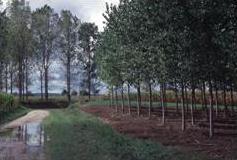
Credits: Marc Villar |
About 30 species of
aspen and poplars colonize the immense territories of the Northern
Hemisphere - from the boreal forest to the banks of the valley of the
Loire - and their inter-American (Populus trichocarpa x
deltoides) and Euroamerican (P. deltoides x nigra)
hybrids constitute large planted areas in Europe, Asia and North
America. In France, poplars are the second most important deciduous
species for the production of logs. As a raw material for the veneer
industry, they also constitute a crucial factor in the maintenance of
the diversity of the ripysilves and are a large sink for carbon
dioxide because of their sequestration of a large quantity of
photoassimilates in their wood. This importance for industrial and
environmental forestry explains why biologists and forestry
geneticists have shown so much interest in poplars in the last few
decades. In biology, the poplar owes its notoriety to the fact that is
has been chosen as a model for the study of the development and
function of trees. Its economic value, the existence of protocols for
vegetative multiplication and efficient genetic transformation, the
construction of several genetic maps, together with rapid growth, have
raised the poplar to the rank of model organism for forest
biochemistry, physiology and genetics in only a few years. The
relatively small size of its genome, 520 Mb, is a supplementary
asset. This ensemble of virtues has logically led to the sequencing of its
genome. The research activities developed within the framework of
the ForEST project aim to identify the transcriptional
mechanisms involved in the development of tree-fungus associations and
in the regulation of the formation of wood in response to
environmental constraints.
Interactions between the poplar and biotrophic fungi
This involves:
- the identification of the genes leading to the formation of
symbiotic (ectomycorrhiza) or pathogenic (foliar rust agent)
biotrophic structures and
- to compare the gene networks involved in these two types of
interactions.
Within the ForEST project, the comparative analysis of the
transcript profiles (through EST sequencing) during the colonization
of poplar by the phytopathogenic rust fungus, Melampsora
larici-populina, and the ectomycorhizal fungi, Pisolithus
tinctorius and Laccaria bicolor, allowed the
identification of differentially-expressed genes in these different
biotrophic interactions. The cDNA libraries analysed corresponded to
different stages of development of the infection structures.
Assembly of the different sets of ESTs has generated
526 tentative consensi (TC) of rust-infected leaves, 2570 TC of
germlings from Melampsora larici-populina, 3591 TC of
Populus/Pisolithus ectomycorrhizas, and 1786 TC of
Populus/Laccaria ectomycorrhizas. In addition, we have
analyzed 2020 TC from poplar roots incubated in 50 µM auxin (IAA), a
signaling molecule involved in the ectomycorrhizal symbiosis
formation. Finally, 2183 TC of drought-stress roots of poplar were
generated.
Wood formation in response to environmental constraints
During their long lifespan, trees must confront numerous environmental
constraints. In order to better support these constraints, they have
developed adaptations; some of these are linked to the formation of
wood. It is well established that the relative proportion of the
constituents of the cell wall as well as the size and arrangement of
cells of the xylem determines some of the technological properties of
wood. In fact, the cell wall can be compared to a composite material
which consists of a matrix of lignins, hemicelluloses and amorphous
cellulose, reinforced by long packets of crystalline cellulose
microfibrils. The models derived from the mechanics of composite
materials have shown the importance of the angle of the microfibrils,
the degree of crystalinity of the cellulose and the mechanical
properties of the matrix in explaining the variations in the
properties of the wood. Thus it is probable that the genes implicated
in the construction of the cell wall play a primordial role in the
definition of the properties of the wood.
Furthermore, there are very delicate mechanisms
which permit the tree to regulate the differentiation of the wood
cells in response to different environmental constraints. When
deciduous trees are subjected to a mechanical constraint provoked by
the leaning of their trunk, they respond by producing a specific type
of wood, tension wood, which permits them to reorient their axes in
fine. Compared with normal wood, tension wood is characterized by a
reduced number of vessels and more numerous fibers, and by cell walls
which are much thicker. Likewise, when submitted to a moderated water
stress, the tree will react at the level of wood differentiation :
vessels will be smaller but more numerous whereas there will be less
fibres. Our objective is to identify genes implicated in the formation
of wood and which are important for the adaptation of trees to their
environment. These candidate genes will be useful for creating
improved forest varieties adapted to a changing environment and which
will produce quality wood.
|





 home |
overview |
resources |
sequencing |
news |
press releases |
site |
Legal information

