Rationale for a DNA sequencing center
After studying the genes of organisms one at a time, biologists next wanted to create an exhaustive inventory of the genes. In order to accomplish this, they needed to be able to access the ensemble of the hereditary information of an organism - the genome - contained in its chromosomes. The chromosomes are huge molecules of DNA, formed by a long chain of dozens, or even hundreds of millions of nucleotides (the "letters" of DNA) in humans. Before scientists can produce an inventory of the genes, they have to determine the order, or sequence, of these millions of letters.
Unfortunately, it is impossible to read the sequence of a chromosome in one go; each sequencing operation, or read, can only produce a sequence of 500 to 1000 nucleotides. Moreover, redundant sequencing is necessary in order to ensure high-quality reads and assemble the resulting sequences. The determination of the complete sequence of a human chromosome thus requires millions of reads.
For economic reasons, it is much more efficient to perform these millions of manipulations on a large scale in purpose-built structures which are known as "genome centers." The work is organized and partially automated such that thousands or even tens of thousands of reads per day can be produced at a cost which is much less than in a small laboratory.
These centers have been established in the United States, in the United Kingdom, in Japan, in China, in Germany and in France, where Genoscope is the only structure of this type.
summary
History of Genoscope
Beginning in 1993, The US and the UK initiated large-scale sequencing programs. They were soon joined by other countries in the "Human Genome Project." In 1997, France decided to join this consortium by creating a large sequencing center.
- 18 December 1996: Creation of a Public Interest Group ("Groupement d'intérêt public", GIP) named "Centre national de Séquençage" (CNS, also named Genoscope) for 10 years (Official Journal, 1 January 1997).
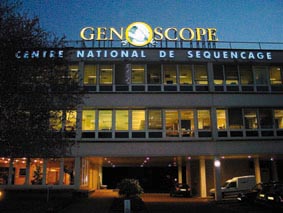
- November 1997: Beginning of activities in newly-renovated premises in Evry.
- 1 July 2002: Integration of Genoscope within a new GIP, "Consortium National de Recherche en Génomique" (CNRG), created for 12 years, which also includes the Centre National de Génotypage (CNG) and the Réseau National des Génopoles (RNG).
summary
Genoscope's Missions
Genoscope - Centre National de Séquençage - is the first large biological facility of its type in France: analogous to large telescopes for astronomy or particle accelerators for physics, its services are available to the scientific community at large, within the framework of collaborative projects with public sector laboratories, or contracts with the private sector. In parallel, the center has its own projects.
The mission of Genoscope is to produce and interpret large volumes of high-quality sequence data. The genomes sequenced and analyzed belong to diverse organisms (microbes, plants, animals, humans) of scientific, medical or economic interest. An essential portion of the activity of the center is the development of informatic methods for the analysis and comparison of genomes; these
research activities are organized within the framework of a
Mixed Research Unit ("Unité mixte de recherche", UMR) of the CNRS. At the end of February 2003, Genoscope had 153 employees (full-time equivalents).
summary
Organization of activities at Genoscope
At Genoscope, as in the other large sequencing centers around the world, the acquisition and interpretation of sequence data is performed in stages, each one of which is carried out in a specific laboratory.
First, DNA is extracted from the cells, and cut into short segments (1000 to 3000 nucleotides), which can be "read" in a single sequencing reaction. The DNA fragments are isolated and propagated (cloned) in bacteria. The cloning laboratory, which supervises these first steps, constitutes collections of these fragments, or clone libraries.
In the case of large genomes (those of plants and higher animals), the DNA must be cut into segments of very different sizes in order to give information about the genomic "landscape" at different scales. In the so-called "clone-by-clone" or hierarchic method, the order of large genomic fragments (50,000 to 200,000 nucleotides or more) along the chromosome is determined as a first step. This operation, which creates a map, is carried out by the mapping laboratory. The large ordered segments are then cut into smaller fragments for sequencing. These small fragments are then allowed to multiply and stored in the form of a bacterial clone library (see previous paragraph).
The template preparation workshop purifies the fragments to be sequenced in sufficient quantities, by extracting them from bacterial cells which have been allowed to multiply in culture.
Each fragment is then submitted to the sequencing process (an ensemble of biochemical reactions) in the sequencing laboratory. The analysis of the products of the sequencing reaction, called a "read", is performed by automatic sequencing machines based on the principle of gel electrophoresis. The multicapillary machines used at Genoscope automatically load and separate the products of the sequencing reactions in very thin capillary tubes. The sequence data from the machines are subjected to several quality control processes and treatments which are performed by the informatics department. This group has developed automated procedures for the daily treatment of large volumes of data.
The sequences of segments from the same genome, or from the same large fragment, are compared with each other in order to identify the places where they overlap; in this way, their order can be determined (assembly). The reassembled sequence is then subjected to interpretation at different levels, using informatics tools. One first tries to detect the instructions (genes) which are dispersed along the sequence. Once validated, the data is made available to the international scientific community, being placed on the Internet, or in public databases.
Finally, the technology development service develops robots which can carry out the repetitive manipulations which are very numerous in the production chain.
summary






 home |
overview |
resources |
sequencing |
news |
press releases |
site |
Legal information

