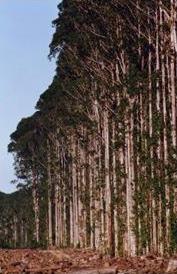
Eucalyptus (photo JM Gion, CIRAD) |
Its rapid growth as
well as its wood quality make eucalyptus the first plant species for
industrial plantations in the world. It is also a good model for
forest species for genomic approaches on wood formation and adaptation
to abiotic stresses according to its small genome size, the
availability of genetic maps and QTLs.
The different Eucalyptus projects being carried on in our research
institute aim at deciphering the molecular mechanisms involved in wood
formation and cold tolerance. Furthermore, beyond these studies of
fundamental importance, both teams involved in these projects are
determined in finding industrial developments in relationship with
wood quality improvement and the broadening of the geographical areas
of industrial plantations towards temperate zones, including France.
Genetic control of wood formation
Our research work focuses on a plant specific developmental process
which gives rise to the formation of a highly specialised complex
tissue, the secondary xylem. In trees, wood or secondary xylem,
originates from a meristematic tissue, the vascular cambium. The
formation of xylem is a fascinating example of differentiation which
necessitates the spatial and temporal coordination of the expression
of several hundreds of genes involved in cell division, elongation,
formation of a lignified secondary wall and programmed cell death. The
secondary walls of xylem cells possess unique characteristics
(biochemical composition and tridimensional association of polymers)
which govern the intrinsic properties of wood of forestry trees.
The aim of our project is to identify and functionally characterize
the genes involved in the genetic control of wood quality in
Eucalyptus, more particularly transcription factor genes involved in
xylogenesis. The developped strategy consists in searching a
statistical relationship between a polymorphism of candidate genes and
permanent quantitative features related to wood quality. This issue is
carried on in a collaborative project with CIRAD through genetic
mapping of the candidate genes and search for colocalisation with QTLs
related to wood quality.
In order to identify putative candidate genes related to wood
formation, 13,000 ESTs from one normalized Eucalyptus xylem cDNA
library and several SSH subtractive libraries containing
xylem-preferentially expressed genes will be sequenced in the frame of
this project.
Genes involved in cold tolerance
This program on Eucalyptus is focused on the molecular mechanisms
associated with cold, a very important environmental factor affecting
plant growth, productivity and plantation areas, especially in
France. Based on a transcriptome analysis, the project aims to
identify and study a pool of genes involved in the intrinsic cold
tolerance as well as in the induced tolerance, known as cold
acclimation and occurring after a cold treatment (non-freezing
temperature) associated with a decrease of light and photoperiod.
first goal of our program concerns the in-depth functional study of
selected genes to understand the mechanisms of frost tolerance, and
the second goal is the identification of candidate genes for the
design of reliable markers for assisting genetic selection (MAS).
In a first step, two cDNA libraries were made as sources of genes: a
subtractive acclimation cDNA library from a cell suspension culture
and a total cDNA library from leaves of cold acclimated plantlets
(cold-tolerant genotype). 13,000 clones from these libraries will be
sequenced in this project.
|





 home |
overview |
resources |
sequencing |
news |
press releases |
site |
Legal information

