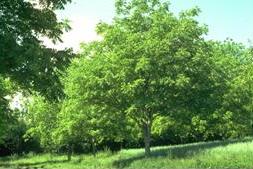
Credits: JM Gion, CIRAD |
Duraminization is the ultimate process
of differentiation of wood cells and leads to the formation of the
heartwood or duramen. It is responsible for the principal chemical
(durability) and esthetic (color) properties which condition its
utilization. Depending on the species, the characteristics of the
heartwood are extremely variable. Some species, such as the walnut and
the larch, produce highly colored heartwood which cannot be clearly
differentiated from the sapwood in terms of color or durability
(poplar).
The study of the formation and variability of the
characteristics of heartwood is being approached by our group in
species with well differentiated heartwood such as the cherry tree,
teak, larch and walnut. For example, the walnut produces high quality
wood which is colored and very sought after for cabinetmaking. We have
chosen it as a model to study the physiologic and genetic mechanisms
which regulate the production of phenol compounds synthesized during
the formation of heartwood, and which are responsible for the color of
the wood.
In general, the formation of heartwood is studied
using descriptive (histology and analysis of the image of its
extension), analytic (biochemistry and molecular biology) and genetic
(selection and improvement programs) techniques.
In the walnut tree, our research mainly targets the
study of phenol compounds (phenylpropanoids, flavonoids and
naphtoquinones) (Burtin et al., 1998) and the enzymatic systems which
control their syntheses (chalcone synthase, flavanone 3-hydrolase,
dihydroflavonol 4-reductase and beta-glucosidase) (Duroux et al.,
1998). At the level of the transition zone, beta-glucosidases may play
a dominant role in the synthesis of juglone, a naphtoquinone
characteristic of heartwood. The purification and determinaiton of the
biochemical characteristics of this class of enzymes are in progress.
The development of molecular biological techniques
is much more recent due to the problems inherent in the small numbers
of living cells and the large quantities of phenol compounds present
id old wood tissue (Label et al., 2000, Beritognolo et al., 2002).
We have constructed a library of cDNA which is
reprresentative of the genes expressed in the sapwood-heartwood
transition zone. Over 2000 clones have already been sequenced and
annotated in the framework of collaborations with UREFV
(INRA-Bordeaux) and the HTIRC (Purdue University, USA).
The comparison of expressend sequences in the
different wood tissues (cambial zone, xylem and transition zone) and
the utilization of microarray technology will make it possible to see
which metabolic pathways are activated or repressed at all stages of
differentiation of the wood, and also during infection of trunks by
Erwinia, which is a major menace for the production of
walnuts in France. This infection causes branches used for carpentry
to fall; up to 80% of the trees are affected in certain areas in
Isere. Based on the ESTs from resistant genotypes (J. nigra,
J. regia x J. nigra) which are available only to our group,
we can envisage collaborations with California (which is also
affected) (UC Davis, Prof. G. McGranahan and A. Dandekar).
On the longer term, fundamental and technical
knowledge acquired on the formation of heartwood in the walnut tree
could be transferred to other species in order to study other aspects
of duraminization. Because of the more and more restrictive European
measures regulating chemical treatment of wood, the natural durability
and the identification of the metabolic pathways which are involved
constitute a research axis which may have important economic and
ecologic consequences. The characterization and utilization of
molecules of interest such as the phenolic molecules found in the
duramen of certain species (tannins, flavonoids, naphtoquinones) with
strong antioxidant properties which are toxic for pathogenic organisms
(bacteria, fungi, insects) represent a future pathway for enhancing
the value of wood products.
|





 home |
overview |
resources |
sequencing |
news |
press releases |
site |
Legal information

