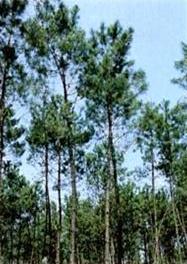
Credits: JM Gion, CIRAD |
Maritime pine is a
major component of the French forest, where it covers 1.5 million
hectares, or 10% of the national forest surface. With an average
productivity of 9 m3/ha/yr, it represents 30% of the national
production of coniferous wood. Outside of the Aquitaine massif (about
1 million ha), it is found in the west (Poitou-Charentes, Vendée,
Sarthe, Basse-Normandie), in the Central region (forêt d’Orléans,
Sologne), as well as in the Mediterranean zone (Cévennes, Corbières,
Var, Alpes maritimes, Corsica). In Aquitaine, it is not only of
ecologic value (this French region has the highest level of
forestation), but it is also of indisputable economic importance,
accounting for 30,000 jobs and a turnover equal to that of Bordeaux
wines. The maritime pine forest also plays a key role in regional
development of rural areas. The articulation between the resource and
industry occurs as a coupling. This is expressed at the research level
by strong wood science and genetic research, two disciplines which
are being developed at the Forêt-Bois de Bordeaux-Pierroton research site.
The research activities which will use the genomic
resources produced in the framework of the ForEST project and
which already exist, aim to identify the genes implicated in the
genetic control of wood quality and in the adaptation of maritime pine
to water deficit.
Wood quality: The wood available as a raw
material to Aquitaine manufacturers in the forest-wood-paper sectors
does not always have the desired chemical and technological
characteristics. Thus, although the stated objective of the research
is to increase the yield of the wood, breeding efforts are oriented
towards quality today. Measurements of wood properties are
excessively costly and laborious, and it is hard to envisage using
them in breeding in view of the constraints imposed by a tree
improvement programme (thousands of measurements would be
required). Thus marker-assisted selection (MAS) becomes of great
importance. Since forest species are allogamous and not highly
domesticated, the application of MAS at the population level should
resolve the problem of the absence of physical linkage disequilibrium
between alleles of markers and QTL alleles. The discovery of genes
directly involved in the expression of traits of interest is
therefore an essential step. It is a matter of choosing (molecular
sorting, which is cheap and can be done early) among the collections
of elite genotypes which have already been selected for vigor, those
which possess forms which are favorable at the level of the genes
controlling traits of interest, in order to create varieties with
high technological performance rapidly. The target characteristics
for breeding are:
- lignin and cellulose content and fiber morphology, which
condition the efficacy and profitability of paper processes,
- the technological properties of the fibers and aggregates for
composites (especially panels) and
- modulus of elasticity for utilization in carpentry.
This research programme responds not only to a need
for purely scientific knowledge about molecular mechanisms involved in
wood formation, but also targets a regional economic need.
Water and wood: The water supply constitutes
the principal limiting factor for growth and survival of plants. For
example, a maritime pine consumes around 800 to 900 liters of water in
order to produce one kg of wood. This amounts to 400 m3 of
water for 1 m3 of wood. However, we now know that in the
next 50 to 100 years, global climate change will lead to a significant
decrease in precipitation and an increase in summer temperature in the
southern half of France. It is therefore likely that in the near
future plants will have less water available than at the beginning of
the century. Fifty years is just the time scale which corresponds to
the duration of the life of a maritime pine forest, from when it is
planted until cutting of the timber. It is therefore important to know
if these organisms can support sudden climate changes; in other words,
can the improved varieties that are planted today maintain the current
productivity levels in an environment with less water, and can they
tolerate episodes of intense drought? In fitting models of future
climatic evolution with our knowledge on forest functioning, the
ecophysiologists are already predicting a drop in productivity for
maritime pine forests beginning in 2040 (especially in the Aquitaine
massif). Scientists who are studying genetic factors that account for
tree water use efficiency have furthermore shown that for the same
quantity of water consumed, all trees do not produce the same quantity
of wood. It therefore seems possible to utilize this variability to
adapt our forests to a dryer climate, in particular by creating
improved varieties which can maintain a reasonable growth rate and
economize water at the same time, thus guaranteeing the sustainability
and future competitiveness of the forest-wood-paper sector.
With the support of the Genoscope (ForEST
project), the molecular biologists of INRA have recently begun the
decoding of a part of the genome of the maritime pine, specifically
targeting the genes which control the response of trees to
drought. This involves both an understanding of the intimate
mechanisms (at the physio-molecular level) used by Maritime pine to
resist a more or less pronounced water deficit, and a study of the
natural diversity which exists at the DNA level to help geneticists
select the trees which are best adapted to the goal of production
under dry conditions.
|





 home |
overview |
resources |
sequencing |
news |
press releases |
site |
Legal information

