Vitis vinifera
Vitis vinifera (2n=38) is part of the Vitaceae
family, which comprises 17 genera, mostly woody or herbaceous lianas
primarily inter-tropical in their distribution. Only one genus,
Vitis, produces edible berries. It contains about 60
dioecious species that are distributed almost equally between America
and Asia and represent a considerable resource for resistance to
pathogens (Mullins & al, 1992). Vitis vinifera L. is the only
species originating from Eurasia and it has been spread throughout the
world by human cultivation. The Vitaceae family is a basal
family of the rosids (Jansen & al, 2006).
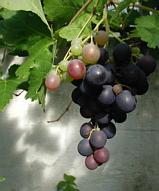
Photo of a grap of Vitis
vinifera (Author and credit: Sten. Photo from the website http://www.wikipedia.fr) |
The number of chromosome per haploid genome across the
Vitacea family varies from 11 to 20. Cytological observations of F1 hybrids between Vitis
vinifera (2n=38) and Muscadinia rotundifolia (2n=40),
suggested an allopolyploid origin of the Vitis genome
(Mullins & al, 1992).
Perennial liana like Vitis vinifera have many developmental
aspects different from Arabidopsis, poplar, Medicago and tomato, which
include a unique shoot architecture with petiolated leaves opposite to
either inflorescences or tendrils. Inflorescences
have a pyramidal branched structure with an asynchronous development
of flowers. The five petals of the flowers are jointed into a cap
structure which falls at anthesis, liberating the stamens and the
pistil. Particularly adapted to avian
dissemination, the berry pericarp undergoes multifaceted metabolic
changes common to most fleshy fruits species as they shift from a
repulsive to an attractive status. The transition between these two
status is abrupt and the trigger remains unknown (Mullins & al). Unlike in tomato, berry ripening occurs without an increase in
respiration, or a significant emission of ethylene.
References
- Jansen RK, Kaittanis C, Saski C, Lee S-B, Tomkins J, Alverson AJ, Daniell H.
"Phylogenetic analyses of Vitis (Vitaceae) based on complete chloroplast genome sequences :
effects of taxon sampling and phylogenetic methods on resolving relationships among rosids."
BMC Evolutionary Biology. 2006, 6 : 32L
- Mullins MG, Bouquet A, Williams LE.
"Biology of grapevine."
Cambridge University Press, Cambridge. 1992.
Funding agencies :












 home |
overview |
resources |
sequencing |
news |
press releases |
site |
Legal information

