Whole genome shotgun sequencing of Vitis vinifera
Why sequence the genome of the grape?
 *
The grape constitutes a major species for European agriculture. In
order to increase its economic competitivity and to adapt its
cultivation to new production objectives which result from climate
change, the emergence of new diseases, environmental protection
imperatives and consumer behavior, it is necessary to increase our
knowledge of its physiology and pathology, and to develop genetic tools
and resources for its amelioration.
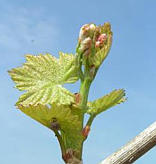
Credits: Virginie Curtil |
Although its biology precludes its
usefulness as a model organism (it is a perennial plant with high
heterozygosity and a long reproductive cycle), it has rapidly become
evident that it is not only possible, but even necessary to develop
the genomic tools to accelerate the acquisition of knowledge about
important agronomic characteristics such as resistance to diseases,
tolerance to abiotic stress, maturation and quality of the fruit. One
of the objectives of the consortium was the establishment of a
sequencing project for the genome of the grape.
The recent availability of the sequence of model species genomes
like Arabidopis and rice (and soon coming of
Medicago, poplar and tomato) together with the fact that the
grape genome is small (475 Mb), leaded the scientific community
working on grapevine to create a consortium, the International Grape
Genome Program (IGGP), aiming at the coordination of
the development of genomic resources in grapevine .
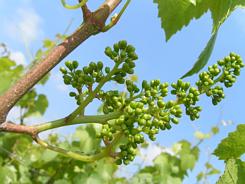
Credits: Virginie Curtil |
A knowledge of the genome of the grape will considerably encourage
the transfer of results from model organisms involving the molecular
mechanisms implicated in important agronomic charactistics which are
already known, to the grape. Information about the sequences of the
genes of the grape is necessary to better understand its biological
features: perennial nature, fleshy fruit, maturation signals which
are different from those of the tomato, tendency to be dioecious,
etc. It will lead to functional genomics approaches which have shown
their value and efficacity for the study of complex characteristics in
other species. Special attention will thus be given to regions which
carry "clusters" of sequences which are homologous to genes for
resistance or defense against diseases; an understanding of these will
facilitate the exploration of genetic resources and access to the
alleles implicated in these mechanisms. This information should also
make it possible to respond to a great need for markers of the
physiological state of the plant in the vinyard in order to develop
tools for a more precise viticulture which is more sustainable and of
high quality (adaptation to hydric stress, the relationship between
technological quality and the state of maturation of the fruit, etc.).
Up
Creation of a Franco-Italian project
In autumn 2004, following pressure from the international community on
the positioning of France in the context of the sequencing of the
grape genome, the Scientific Council of Genoscope emitted a favorable
recommendation for the sequencing of this genome using a whole genome
shotgun strategy with three-fold coverage. In parallel, the Institut
National de la Recherche Agronomique (INRA)
applied to the Agence Nationale de la Recherche (ANR) for
complementary sequencing at the level of 6 genome equivalents. ANR
gave Genoscope a positive response to this application in May 2005,
and in July 2005, France and Italy (University of Padua, University of
Milan and the University of Udine) signed a collaborative agreement
for the sequencing of the genome of the grape. The Italian
contribution will involve the sequencing of at least 3 genome
equivalents. The Franco-Italian program for sequencing the grape
genome will lead to a minimum coverage of 12 genome
equivalents. Furthermore, the program for the grape genome is
co-ordinated with the sequencing of a strain of yeast (EC-1118) which
is used in vinification and with a strain of the pathogen agent Botrytis cinerea.
Up
Strategy
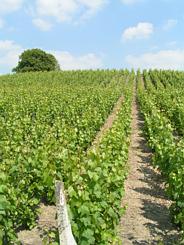
Credits: Virginie Curtil |
The sequencing of the genome of
Vitis vinifera is being performed on
the quasi-homozygous genotype PN40024 which was created by INRA in
Colmar (
Bronner and Oliveira,
1990). The size of its genome is estimated at 475 Mb (
Lodhi and
Reisch, 1995). The chosen strategy is whole genome shotgun with a
minimum coverage of 12 genome equivalents. Several plasmid libraries
with different insert sizes (3 and 10 kb) have been constructed and
are currently being sequenced. A
HindIII BAC library of
70,656 clones has been constructed and the end-sequences obtained. In
addition, a fosmid library (35 kb) is being constructed in order to
obtain the long-distance clone links necessary for assembly. The
ensemble of the sequences obtained will be assembled using the
ARACHNE
assembler (Broad Institute) and an automatic annotation will be
performed.
In parallel, a physical and genetic map comprising more than 1,500
markers will be constructed. It will permit anchoring and orientation
of the super-contigs on the 19 chromosomes.
Up
References
- Bronner and Oliveira (1990) Creation and study of the Pinot Noir variety
lineage. In: Proc. 5th Intern. Symp. Grape Breeding St Martin/Pflaz,
Germany, Sept 1989, Vitis, special issue, pp69-80
- Lodhi MA, Reisch BI (1995) Nuclear DNA content of Vitis species,
cultivars and other genera of the Vitaceae. Theor Appl Genet, 90 : 11-16
- ARACHNE: A Whole-Genome Shotgun Assembler, Genome Research, January
2002.
- Whole-Genome Sequence Assembly for Mammalian Genomes: ARACHNE 2, Genome
Research , January 2003.
Up
* Photo of a pinot meunier leaf by Vincent Dumas (INRA)










 home |
overview |
resources |
sequencing |
news |
press releases |
site |
Legal information

