|
Presentation
Preamble
The elucidation of the ensemble of the metabolic reactions in a prototrophic (1)
organism is a fundamental objective in the comprehension of vital processes. A knowledge of this ensemble is a prerequisite to a truly predictive modeling
of the flux of matter and energy in cells, their integration and their regulation. It is often asserted that the inventory of the steps in bio-conversion
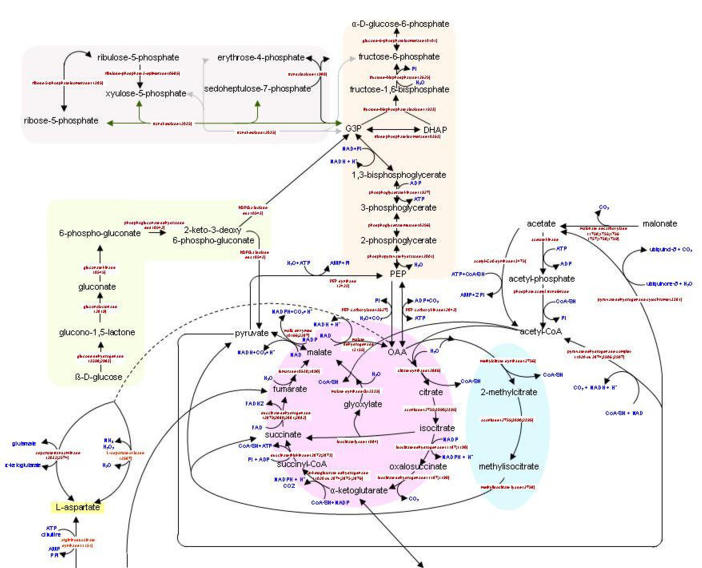
is almost complete. However, even superficial observations, as well as tools for the representation of metabolic data
(KEGG, BioCyc), have shown that this is not true
and there are enzymatic activities for which the genes are unknown. Access to the sequences and therefore to the ensembles of genes from complete genomes
(over 300 bacterial genomes have been sequenced to date) can be used today for an in-depth re-examination of the metabolic functions of a bacterial organism.
Click the image to enlarge |
Top of page
Acinetobacter baylyi : a new model for the study of bacterial metabolism.
After an extensive inventory of species described in the literature, we noticed that the species Acinetobacter
baylyi, which was isolated from soil, presents real advantages as a model for the study of bacterial metabolism. A. baylyi has the highest capacity for transformation by exogenous DNA (natural compétence (2)) of any micro-organism. This property, associated with its capacity to undergo homologous recombination (3), makes genetic modification very easy. This is a process of targeted exchange (directed mutagenesis) which permits specific modification of genetic information at a given locus.
A. baylyi belongs to the gamma proteobacteria like E. coli with which it shares 46% of its genes. Furthermore, it has several decisive advantages compared with E. coli : natural competence, faster growth on minimal media and no metabolic ambiguity (strictly aerobic).
Development of resources for the systematic study of the A. baylyi genome
Sequencing and annotation of the genome
With the goal of developing a genetic model which can be manipulated more easily than E. coli,
we have undertaken the systematic analysis of the genome of A. baylyi in order to gain a more complete and detailed knowledge
of its metabolic functions. With this objective, the sequencing of the genome has been performed at Genoscope, followed by annotation
with the participation of experts on bacterial metabolism (V. Barbe & al., 2004).
Of the 3205 CDS (4) annotated, 36% have a known function,
28% a "probable" function and 36% have no known function. Furthermore, this first analysis demonstrated that the A. baylyigenome,
which is more simple than that of E. coli, includes fewer gene duplications. This should simplify the phenotypic analysis of mutants considerably.
A special effort was made in the reconstruction of the metabolic pathways of this bacterium.
Establishment of a collection of replacement mutants
The systematic analysis was followed by the establishment of a collection of replacement mutants for each CDS
which was identified in the course of annotation of the genome. Of 3205 CDS, 2468 replacement mutants were obtained (77%). We were not able
to obtain mutants for 480 genes. Unless this was due to technical problems, these genes probably correspond to essential genes (under the
conditions used to obtain these mutants).
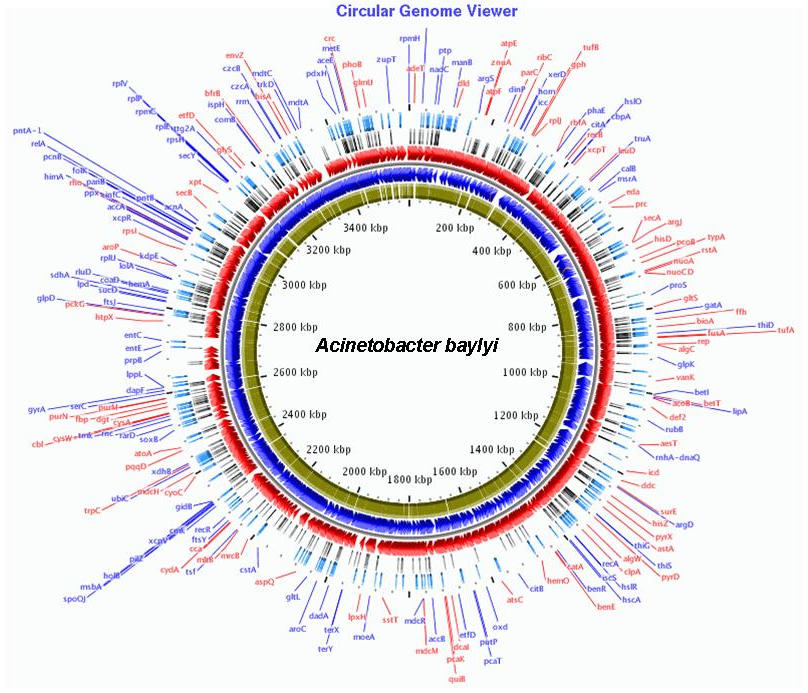
Circular representation of the genome of A. baylyi (Red and blue): genes localized on the (+) and (-) strands. (Green): genes for which a mutant has been obtained. (Black): Genes for which no mutant was obtained. (Light blue): Enzymes of a biosynthetic pathway.> |
Top of page
Approaches for the re-examination of the metabolism
The goal of the Metabolic Thesaurus project is to re-examine the metabolism of A. baylyi and in particular
to extend our knowledge of the enzymatic functions of the cell. As a first step we are concentrating on carbon metabolism. Using our
mutant library, we will generate hypotheses on the function of certain genes by combining experimental data with current knowledge
about metabolism (from expert annotation) and bio-informatic analysis such a conservation of synteny (5) or searching for protein
motifs or domains. We will attempt to classify the mutants into specific metabolic contexts using data from growth phenotypes and
metabolic profiles.
This type of analysis should make it possible to obtain information about "candidate" genes for an unknown metabolic function. As a function of this information we will be able to test for the suspected enzymatic activity of the protein encoded by the gene or try to identify metabolites which differentiate the wild type from the mutant, which would be evidence for the enzymatic activity of the product of the "candidate" gene.
Glossary :
(1) Prototrophic organism : Organism which can synthesize all the substances necessary for its survival by itself.
(2) Competence (of a bacterium): : Capacity of a bacterium to incorporate foreign DNA.
(3) Homologous recombination : Process of exchange between two identical regions of DNA.
(4) CDS : Coding DNA Sequence.
(5) Synteny : When genes are in the same order in related species, they are said to be syntenic, or "in synteny."
Collaborations :
Group members
Top of page
Updated on december 19, 2007
All the photos of the page, except opposite indications, are the property of Genoscope
| 




 home |
overview |
resources |
sequencing |
news |
press releases |
site |
Legal information

