| -> Access to sequencing project |
|
Collaboration
 Unité Biologie Intégrative et Virologie
des Insectes (BIVI)
UMR 1231 INRA - Université Montpellier II
Montpellier, France- Institut de recherche sur la Biologie de
l'Insecte
UMR CNRS
Université François Rabelais
Tours, France
|
|
The wasp,
Hyposoter didymator, lays its eggs and develops in the body
of caterpillars (OR, larvae) of the Noctuidae family, a family of
moths which includes numerous species of economic interest. The strain
of the wasp studied comes from the south of Spain, where it is one of
the natural enemies of the cotton tree worm, Spodoptera
littoralis, a polyphagic pest from Egypt which is present
throughout the Mediterranean basin. In the laboratory,
H. didymator is grown on the species, Spodoptera
frugiperda, (fall armyworm is its common name), a pest which is
present on the American continent.
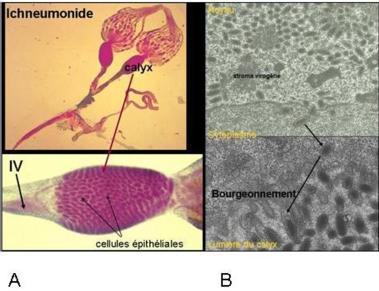
Figure 1 :
Morphogenesis of viral particles in Hyposoter
didymator. A. Feulgen staining (DNA is colored red) of ovary
showing the calyx and the epithelial cells in which the virus
replicates. B. Transmission electron microscopy of sections showing
the production of viral particles from a virogenic stroma in the
nucleus of epithelial cells of the calyx (above). The viral particles
are budding towards the cytoplasm, and then toward the lumen of the
calyx where they accumulate to form the « fluid calyx »
N. Volkoff and M. Ravallec) |
Like other parasitic wasps (see Cotesia
congregata), H. didymator requires a symbiotic virus
of the polydnavirus family for its development in the
caterpillar. This virus is produced in the ovaries of the female wasp
(Figure 1), where it is stored. Therefore, when the female wasp lays
an egg in the caterpillar, the viral particules are injected
simultaneously (Figure 2). In the caterpillar, the viral particles
infect numerous tissues and the viral genes are expressed. The viral
proteins thus produced act at different physiological levels in the
caterpillar, modifying its physiology in an advantageous way for the
parasite. In fact, the virus is indispensable for the development of
the wasp in the caterpillar’s body. The major effects on the
parasitized caterpillar provoked by the presence of the polydnavirus
are the inhibition of the defensive immune response (which is normally
triggered following detection of a foreign body such as the parasite’s
egg) and the perturbation of larval development.
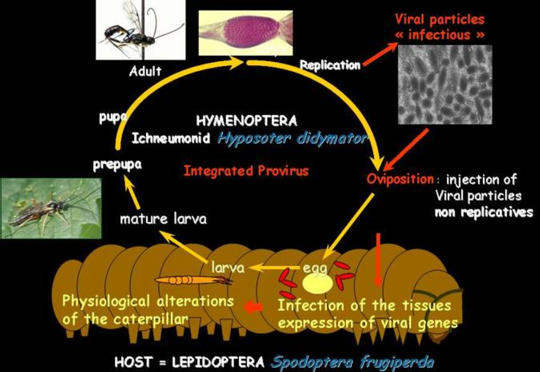
Figure 2 :
Two superimposed cycles of the wasp Hyposoter didymator and
its polydnavirus (HdIV). The first cycle (yellow) indicates the
integrated form (provirus) in which the viral genome is included in
the chromosomes of the wasp. The second cycle (red) indicates the free
form (viral particles). |
The polydnaviruses are classified in two families,
Bracovirus and Ichnovirus, which are associated with wasps from the
Braconide and Ichneumonides families respectively. The polydnavirus
associated with H. didymator, HdIV, belongs to the Ichnovirus
family, whereas the one associated with the wasp,
C. congregata, CcBV, belongs to the Bracovirus family. Thanks
to phylogenetic studies, scientists are in agreement that these two
polydnavirus families are the result of independent association
phenomena between an ancestral virus and and an ancestral wasp (Figure
3). In addition to the evidence from phylogeny, several other types of
evidence contribute to this conclusion:
- the morphology of the
virus particles and different morphogenesis in the two families
- and the genomes of the ichnoviruses have practically no similarity to
those of the brachiviruses (not detected with BLASTN or BLASTX).
These divergences, which are associated with a convergence of effects
on the physiology of the parasitized caterpillar, raises the important
question of whether these two polydnavirus families have distinct
evolutionary origins and perhaps different modes of production.
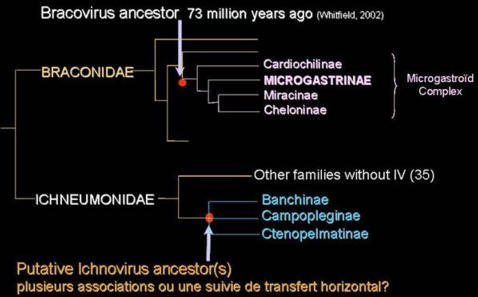
Figure 3 :
Schematic representation of associations from which the two families
of polydnaviruses originated, the bracoviruses (associated with the
Microgastroides braconid group, monophyletic) and the ichnoviruses
(associated with various sub-families of
ichneumonides). |
In contrast to the situation with brachovirus, the
genome of ichnovirus is still poorly known because this polydnavirus
family has been studied by only a few laboratories in the world. Only
the virus associated with Campoletis sonorensis, CsIV, has
been sequenced: it consists of 22 segments of 6 to 20 kbp (total size
of 223 kbp). Furthermore, the genome of CsIV contains some molecules
which are closely related (« nesting » which some segments are
generated by recombination from a larger segment), a phenomenon which
has not been widely documented in Bracovirus. As for HdIV, the number
of segments which constitute its genome is not known, but is around
20, with sizes which vary from 2 kb to more than 10 kb (Figure 4).
In order to understand the role of these viruses in
the parasitic success of the wasp it is important to identify the
proteins expressed in the lepidopteran host. We have identified 28
genes to date, which have been classified in 12 families. Of these
genes, 70% have no homology with genes which have already been
described and 40% are genes which have not been described in other
ichnoviruses. At the moment, the organization of the genome in the
viral particles seems to follow the same criteria as for the
bracovirus CcBV: genes organized in families, genes for virulence
factors, characteristics of the eukaryotic genome, absence of genes
which are similar to classical viral genes. However, only the complete
sequence of this genome will make it possible to make solid
comparisons between ichnovirus and bracovirus.
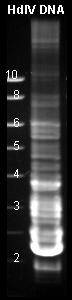
The HdIV genome, extracted from viral particles, is
composed of several circular molecules of DNA in a non-equimolar
ratio. |
This data will also make it possible to address the
question of the evolutionary origin of the polydnaviruses, in a
comparison with the bracovirus associated with
C. congregata. They will be complementary, and necessary for
the analysis of the genes and mechanisms implicated in the production
of viral particles in the parasitoid wasp which the Montpellier group
is also studying.
|





 home |
overview |
resources |
sequencing |
news |
press releases |
site |
Legal information

