|
Analysis of phenotypic profiles
Can the results of high-throughput phenotyping experiments like those performed
in the context of the Metabolic Thesaurus project be exploited systematically in yeast as well, and to a lesser
extent in E. coli, in order to obtain functional information which is more elaborate than that obtained
in specific genetic experiments?
In fact, these experiments make it possible to associate a phenotypic profile with each gene, i.e.
the list of growth phenotypes of the corresponding mutant on all the media tested. To a certain extent,
the similarity between the phenotypic profiles of two genes reflect the proximity of the roles of these genes
in the mechanisms which allow the bacterium to survive on these media. The clustering of genes with similar
profiles can therefore provide strategies for the annotation of genes of unknown function, for example,
by relating them to other genes of known function.
he first step consists of defining one or methods of classification (clustering, biclustering)
adapted to this type of data, calibrating them, and evaluating their pertinence relative to the ensembles
of genes of known function.
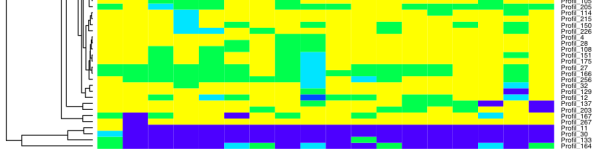
Hierarchical classification of phenotypic profiles
|
For all methods of classification used, the functional interpretation of the groups
of genes obtained is complicated by the fact that only a small fraction of the genes already have an annotation.
A possible strategy is to complete the information contained in the phenotypic profiles using data on functional
relationships between genes either measured or inferred from a different type of experimental data [* Von Mering et al (2005)].
The groups of genes may then be analyzed in the context of a network constituted of functional links which permits the
elaboration of hypotheses for gene function from an extended ensemble of "neighboring" genes. Finally, do the results
of high throughput phenotyping enable better understanding of the link between cellular phenotypes and molecular mechanisms?
In fact, these results correspond to a systematic double perturbation of these mechanisms: deletion of a gene and changes
in environmental conditions. It is possible to interpret them in terms of a network of metabolic reactions, sometimes
complemented by transcriptional regulation links? With this objective we are studying the link between the metabolic
network and the distances between phenotypic profiles.
Bibliography :
[*] Von Mering C, Jensen, Lars J, Snel, Berend, Hooper, Sean D, Krupp M, Foglierini M,
Jouffre N, Martijn A, Bork P.
"STRING : known and predicted protein-protein associations, Integrated and transferred across organisms."
Nucl. Acid Res.2005. (33): D433-437.
Updated on october 12, 2006
All photos & diagrams are the property of Genoscope, unless indicated otherwise.
|





 home |
overview |
resources |
sequencing |
news |
press releases |
site |
Legal information

