Presentation
Created at the end of 2004, the Computational Systems Biology group focuses on the function and evolution of metabolism (1)
using mathematical and computational methods, in close collaboration with teams of experimentalists. The group builds models
of metabolism at the level of the cell, integrating various types of biological data, confronts model predictions against experimental data,
and analyzes these predictions using computational methods.
Metabolic modeling at genome scale
From annotations to models...
The availability of the complete genomic sequence
and corresponding functional annotation for a given genome makes it possible to perform a
first inventory of the set of metabolic reactions which are likely to
occur in the organism, i.e. reactions catalyzed by the enzymes for which
coding genes have been identified. This inventory provides a starting point
for the initial reconstruction of metabolic models, together with physiological knowledge and a specific curation effort.
As additional genes are annotated as having a role in metabolism, or as existing enzymatic annotations are refined, the model can be improved.
...and from models to annotations
As soon as it is sufficiently complete to allow testable predictions about
the global metabolic behavior of the cell, a metabolic model may be used to
evaluate the coherence of the network of reactions deduced from functional
annotations with existing knowledge on the physiology of the organism. This
evaluation is performed by comparing predictions about the metabolic
capacities of the cell, such as its capacity to grow on a given medium or to
produce specific metabolites or combinations thereof, with physiological
information or new experimental data. An incoherence between model predictions
and experimental results may signal missing or inaccurate
elements in the annotation. In combination with the use of other
functional clues, detailed analysis of model predictions then
permits the design of experimental strategies to complete or correct the
annotation.
Metabolic models and experimental data
Metabolic models are doubly constrained by experimental data :
they are reconstructed from data on enzymatic reactions and regulatory
mechanisms predicted from the genome sequence or validated experimentally; and their
predictions are tested against experimental measurements. Their complexity
and level of detail must therefore be commensurate with the nature and
quantity of the data which is experimentally available. Quantitative parameters
are not yet available at the scale of an entire metabolic networks. Qualitative models
can nevertheless yield
biologically relevant insights using structural analyses and predictions
which can be experimentally verified.
A large majority of the phenotypic (2) traits (2) of a bacterium (for example:
is it able to grow on a given medium? Which metabolites is it able to produce ?
How does a genetic disruption modify its metabolic capabilities ?) are
direct consequences of the internal state of its metabolism, i.e. of the set of metabolite
fluxes and concentrations. Metabolic models provide an effective handle on
this relationship, linking genotype and phenotype via a description of
the states of the metabolic network.
Top of page
Modelling framework
The "constraint-based"[*
Price et al. (2004)] modelling framework [Price et al. (2004)] is well
adapted to the study of the metabolism of the whole cell, at a scale for which quantitative data are not available, and complex mathematical treatment is
not possible. It describes the dynamics of the metabolic network in a
stationary state and permits characterization of the distribution of the
flux of material within the network of metabolic reactions as a function of
the chemical composition of the environment, the law of conservation of mass
and supplementary biological or biochemical constraints. When a
"constraint-based" model is sufficiently complete, it also becomes possible to make
predictions about the flux of individual reactions as well as predictions of
growth phenotypes in a given medium depending on a hypothesis regarding a
task which the cell is trying to optimize (production of biomass,
degradation of a toxic substance,...?).
As abstract and simplified representations of metabolism, these
models have two roles :
- Descriptive : they present a view of a structured ensemble of the metabolic
reactions which take place in the cell.
- Predictive : they permit prediction of certain qualitative and quantitative
aspects of the metabolic behavior of the cell in a given environment.
Far from constituting an exhaustive or necessarily very detailed vision of
the metabolic functioning of the real cell, these global metabolic models are
mainly tools for advancing our understanding of the function and metabolic
capacities of a cell, but also the role of each of these reactions which
constitute the pathway, and therefore of the function of the corresponding
genes. They also constitute a starting point for more targeted and detailed
models, via extensions of the modelling framework and integration of
supplementary experimental data.
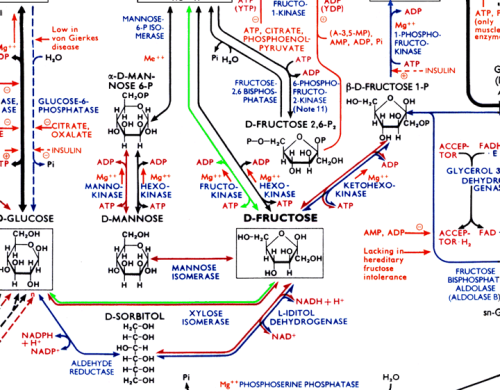
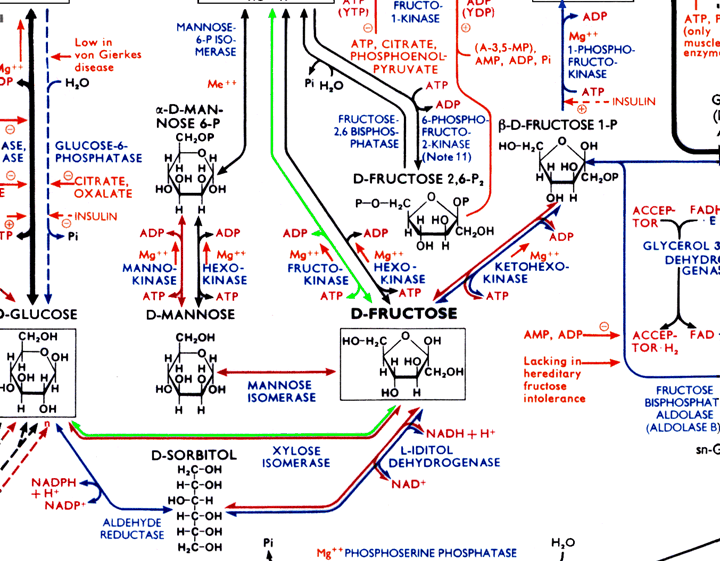
A portion of the metabolic network. (From Biochemical Pathways,
Roche Applied Science, http://www.expasy.org/tools/pathways/)
(Click on the image to enlarge) |
Top of page
Ongoing projects
Each project targets a
biological question in a specific experimental context and/or focuses on the
development of new methods.
Bibliography :
[*] Price ND, Reed JL, et al.
"Genome-scale models of microbial cells: evaluating the consequences of constraints."
Nat Rev Microbiol. 2004. 2(11): 886-97.
Glossary :
(1) Metabolism : Metabolism is the ensemble of molecular transformations and
energy transfers which constantly take place in the cells of living
organisms. It is an orderly process, which includes processes of degradation
(catabolism) and organic synthesis (anabolism).
(2) Phenotype : The phenotype is the ensemble of anatomic, morphologic,
physiologic and ethological characteristics which typify a given living
organism. The phenotype represents the expression of the genotype as a
function of specific conditions in the environment. It is the ensemble of
the observed traits of an organism, resulting from the translation of its
genotype. It is highly dependent on the proteins that it is capable of
producing.
Top of page
Collaborations :
- Metabolic Thesaurus project
- European excellence network ENFIN (Coordination of the workpackage:
"Development of methods for systems modelling")
- European excellence network BioSapiens : development of standards and
methods for the representation and analysis of biological networks in the
context of genome annotation.
- Participation in the BioPAX consortium for the development of a standard of
representation of biological networks.
For more information :
Genomes to Life (DOE): the "Genomes to Life" program site of the American
Department of Energy provides a large panorama of questions related to
function, evolution and the utilization of prokaryotes in which research
uses approaches integrating modelling and experimental strategies.
Group server
Group members
Publications
Top of page





 home |
overview |
resources |
sequencing |
news |
press releases |
site |
Legal information

