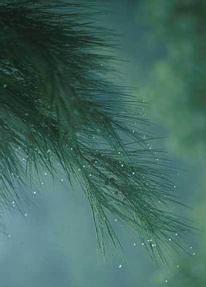
Branch of Filao. The leaves are reduced to scales, which permits to limit transpiration (photo S. Svistoonoff). |
Among higher plants,
the association between Rhizobium and Legumes is not the only one to
have resulted in a nitrogen-fixing root symbiosis. Alder and
Casuarina, more commonly called filao, are actinorhizal
trees, that is able to live in symbiosis with a nitrogen-fixing
actinobacterium called Frankia. As in the case of the
interaction between Rhizobium and Legumes, Frankia
reduces molecular nitrogen into ammonium in specialised organs, the
nodule.
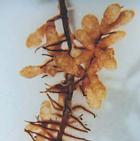
Casuarinaceae multilobed nodule. Each lobe has a lateral root structure with a central vascular bundle and cortical cells infected by Frankia (photo C. Franche) |
Actinorhizal nodules, also called actinorhizae, are most of the time
on the roots, or more rarely on the stems. In general, actinorhizal
plants have a nitrogen-fixing capacity as efficient as that of Legumes
and, even though they have been less studied, they nevertheless
constitute the second group of nitrogen-fixing plants, dominating in
nitrogen-poor ecosystems of temperate regions.
Actinorhizal plants are for the most part trees and
shrubs. Contrary to Legumes that belong to a single family, plants
nodulated by Frankia are characterised by a large taxonomic
distribution; there are about 260 species of actinorhizal plants
distributed in 24 genera and eight families of angiosperms.
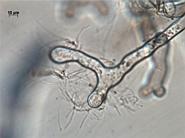
Alnus glutinosa root hairs 14 days after infection by Frankia alni. Numerous deformations at tips are now visibles, they will trap Frankia hyphae and thus permit penetration of the root hair and subsequent nodule induction (photo P. Pujic). |
Their worldwide distribution is vast; they are found on all
continents, save Antarctica. After glacial periods, these plants have
initiated ecological successions, permitting soils enrichment through
high nitrogen and organic matter inputs, and then were replaced by non
nitrogen-fixing competitive plants. Today, they are found in disturbed
environments such as volcanic substrata or mine spoils, and of course
on nitrogen-poor soils such as glacial moraines or sand soils.
References
- Normand P, Lapierre P, Tisa LS, Gogarten JP, Alloisio N, Bagnarol E, Bassi CA, Berry AM, Bickhart DM, Choisne N, Couloux A, Cournoyer B, Cruveiller S, Daubin V, Demange N, Francino MP, Goltsman E, Huang Y, Kopp OR, Labarre L, Lapidus A, Lavire C, Marechal J, Martinez M, Mastronunzio JE, Mullin BC, Niemann J, Pujic P, Rawnsley T, Rouy Z, Schenowitz C, Sellstedt A, Tavares F,Tomkins J, Vallenet D, Valverde C, Wall LG, Wang Y, Medigue C, & Benson DR. 2007. Genome characteristics of facultatively symbiotic Frankia sp. strains reflect host range and host plant biogeography. Genome Research 17: 7-15
- Svistoonoff S, Laplaze L, Liang J, Ribeiro A, Gouveia M.C, Auguy F, Fevereiro P, Franche C, & Bogusz D. 2004 . Infection-related activation of the cg12 promoter is conserved between actinorhizal and legume-rhizobia root nodule symbioses. Plant Physiol. 136: 3191-3197.
|





 home |
overview |
resources |
sequencing |
news |
press releases |
site |
Legal information

