General information about Mycoplasmas
Description of M. hominis
General information about Mycoplasmas
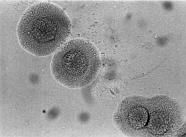
Mycoplasma hominis colonies (credit C. Bébéar) |
Mycoplasma
hominis is a bacterium from the urogenital area which is
pathogenic for humans. This species belongs to the group of
mycoplasmas sensu lato, or Mollicutes ("soft skin"), bacteria
which are characterized by the absence of a cell wall. The Mollicutes
(about 200 species) are rooted in the bacterial taxon of Gram-positive
bacteria with low G+C content, or Firmicutes ("hard skin"), which
possess a thick cell wall. The loss of this cell wall is thus a
derived character state for Mollicutes, which, within the Firmicutes,
are related to the Clostridia and the Bacilli. These last two groups
are probably paraphyletic.
Mycoplasmas are also noteworthy because of the small
size of their cells (0.2 to 0.3 micrometers) and of their genomes
(from 0.6 to 1.4 Mb). They are considered to be the smallest organisms
which are capable of independent replication, and are therefore
studied as a model for a "minimal cell". This is notably the case of
Mycoplasma genitalium : its 580 kb genome (the smallest known
except for those of viruses) was the second bacterial genome to be
sequenced. Reductive evolution of mycoplasmal genomes seems to have
occurred several times, and to have been very rapid.
Because of their reduced genome size, and also their
clinical and veterinary importance, the mycoplasmas have received much
attention from sequencing centers : more genomes have been entirely
sequenced in this group than in any other group. As of Spring 2005,
the genomic sequences of Mycoplasma gallisepticum, M. genitalium,
M. hyopneumoniae, M. mobile, M. mycoides, M. penetrans.,
M. pneumoniae, M.
pulmonis, Mesoplasma florum, Ureaplasma urealyticum/parvum,
Phytoplasma asteris are available (see
references), and many others genomes are in the process of being
sequenced. The genomic sequences of the Mollicutes have a remarkably
low G+C% (U. parvum holds the record for bacteria with a value
of 25.5%). The genus Mycoplasma is also unusual in its
variation of the genetic code : the nonsense codon UGA codes for
tryptophan, a change which could be related to the low G+C% content
(alternative to Trp codon UGG).
The reduction in size of mycoplasmal genomes is
thought to be related to the life style of these bacteria, in close
contact with their host. They are either commensals or pathogens, some
of which arefacultative intracellular parasites. They are found in
both animals (including humans and insects) and plants (Spiroplasmas
and Phytoplasmas). The adoption of an parasitic life style, based on
harnessing of the resources of the host cell, means that numerous
metabolic functions are no longer needed. Mycoplasmas synthesize
indeed few precursors de novo, and the loss of genes for
numerous biosynthetic pathways has been noted in the genomes of the
mycoplasmas that have been sequenced to date. The majority of
mycoplasmas have less than 1000 genes. M.
pulmonis, for example has only 782 genes, compared with 4100
for the related firmicute bacterium Bacillus subtilis. The loss
of the cell wall may also be related to intracellular endoparasitism.
The mycoplasmas, most of which are host-specific,
cause chronic diseases with slow progression in humans and
animals. Human mycoplasmoses are found in diverse diseases of the
respiratory and urogenital tracts. Mycoplasmoses which affect farm
animals cause considerable economic loss. Antibiotic treatment often
fails to eradicate these bacteria. As for other pathogens, it is hoped
that the availability of complete genomic sequences will lead to a
better understanding of the physiology, pathogenic potential and host
specificity of mycoplasmas, and to the development of new prevention
and treatment strategies. The large number of sequenced genomes from
mycoplasma species makes comparative genomics strategies especially
valuable for the prediction of pathogenicity regions and for the
comprehension of the evolution of a very diverse group (in terms of
pathogenicity, host specificity and also morphology and nutritional
requirements). The Molligen database,
which is maintained at the CBiB (Bordeaux 2 University), is dedicated
to the comparative genomics of mycoplasmas.
Up
Description of Mycoplasma hominis
Mycoplasma hominis is one of the four mycoplasma species -
along with M. pneumoniae, M. genitalium and Ureaplasma
urealyticum - for which the pathogenic potential in humans is
certain. Of these four species, M. hominis is the only one for
which the genomic sequence is not yet known. M. hominis is an
opportunistic mycoplasma which, like Ureaplasma urealyticum,
may form part of the commensal urogenital flora of the adult. This is
the mycoplasma species which has the highest probability of being
implicated in genital infections in women. M. hominis may also
cause infections of the newborn and extragenital infections,
especially in immunodepressed subjects. The molecular bases of the
pathogenic potential of M. hominis remain largely unknown.
Phylogenetically,
M. hominis belongs to the same group as M.
pulmonis, M.
agalactiae (genomes sequenced at Genoscope), M. mobile
and M. hyopneumoniae (genomes sequenced as of Spring 2005;
those of other species from this group such as M. arthritidis,
M. orale and M. fermentans, are currently being
sequenced). The comparison of the genomic sequence of
M. hominis (PG21 strain) with those of these closely related
species should lead to a better understanding of the molecular bases
of host specificity. This comparison will be extended to genomic
sequences of other human pathogens (M. pneumoniae, M. genitalium,
M. penetrans and U. urealyticum) which belong to a
different phylogenetic group, in order to identify new factors for
virulence and ecological niches.
The available sequence data is limited in
M. hominis; this includes data on housekeeping genes, and on
membrane lipoproteins - some of which possess adhesion properties -
that display antigenic variations. Such hypervariable systems are
frequent in mycoplasmas. Furthermore, M. hominis has an unusual
type of energy metabolism, based only on the degradation of arginine,
which was not found in the other mycoplasmas which have already been
sequenced; a knowledge of M. hominis genome will open the way
to interesting metabolic reconstitutions. More generally, access to
this sequence will provide fundamental insights into the biology of a
bacterium which is capable of penetrating the interior of human cells.
A knowledge of the genome of M. hominis will
also facilitate the analysis of various strains : clinical isolates
from different parts of the human body, antibiotic-resistant mutants
(from in vivo or in vitro sources) and products of
random mutagenesis by transposition. It will also facilitate the
inactivation of genes of interest.
The in silico annotation of the genome will
be performed in partnership with the laboratory of Bacteriology in
Bordeaux (coordinating group), the UMR "Genomique Developpement
Pouvoir Pathogene" and the Bioinformatics Center of the University of
Bordeaux 2 (CBiB), taking advantage of the ´ CAAT-BOX ª annotation
platform adapted for mycoplasma genomes at CBiB. The interpretation of
data and comparative genomics analyses (using the multigenome database
Molligen developed
at CBiB) will be carried out by the same teams. The in silico
annotation may be extended with proteomic data, using a MudPIT type
approach ("Multidimensional Protein Identification Technology":
separation by 2D liquid chromatography followed by mass
spectrometry). This technology, which is available at the Bordeaux
functional genomics platform, should make it possible to identify more
than 80% of M. hominis proteins and to remove some of the
annotation uncertainties (short CDSs, for example).
Up
References for the 11 other mycoplasma species which have been sequenced. As of Spring 2005, the sequencing of 15 other mycoplasmal genomes is in progress: those of M. agalactiae, M. alligatoris, M. arthritidis, M. bovis, M. capricolum, M. fermentans, M. haemofelis, M. orale, M. synoviae, Spiroplasma citri, S. kunkelii, as well as four Phytoplasmas.
- Mycoplasma gallisepticum strain Rlow
(chronic respiratory disease in chickens, infectious sinusitis in
turkeys)
(L. Papazisi et al., Microbiology (2003) 149: 2307-2316)
- Mycoplasma
genitalium G-37
(human mucous membranes)
(C.M. Fraser et al., Science (1995) 270: 397-403)
- Mycoplasma hyopneumoniae strain 232
(this mycoplasmosis causes a respiratory disease in pigs)
(F.C. Minion et al., J. Bacteriol. (2004) 186:7123-33)
- Mycoplasma mobile
(isolated from the tench, a fresh-water fish)
(J.D. Jaffe et al., Genome Res. (2004) 14:1447-1461)
- Mycoplasma mycoides subsp. mycoides SC strain
PG1T
(causes contagious bovine pleuropneumonia (CBPP), a highly contagious
respiratory disease that takes an heavy toll of subsaharian cattle)
(J. Westberg et al., Genome Res. (2004) 14:221-227)
- Mycoplasma penetrans HF-2
(human respiratory and urogenital tracts)
(Y. Sasaki et al., Nucleic Acids Res. (2002) 30: 5293-5300)
- Mycoplasma pneumoniae M129
(human mucous membranes)
(R. Himmelreich et al., Nucleic Acids Res. (1996) 24: 4420-4449)
- Mycoplasma
pulmonis UAB CTIP
(causes murine respiratory mycoplasmosis (MRM) in mouse and rat ;
model for M. pneumoniae infections in humans and for other
animal respiratory mycoplasmoses)
(I. Chambaud et al., Nucleic Acids Res. (2001) 29: 2145-53)
- Mesoplasma florum L1
(no pathogenicity, found on citrus flowers)
(Web page at Broad Institute)
- Ureaplasma urealyticum (parvum) sv 3
(human mucous membranes)
(J.I. Glass et al., Nature (2000) 407: 757-62)
- Phytoplasma asteris OY-M
(phytoplasmas infect plants)
(K. Oshima et al., Nature Genet. (2004) 36:27-9)
|





 home |
overview |
resources |
sequencing |
news |
press releases |
site |
Legal information

