| -> Access to sequencing project |
|
Collaboration
 Pasteur Institute, Paris - Department of Genetics, University of Alabama, Birmingham, USA
- "Cellular and Molecular Interactions", UMR 6026 CNRS/ Rennes I University
- "Helix" Project, INRIA Rhône-Alpes
- Alain Blanchard, who initiated the project at the Pasteur Institute, leads now the "plant - pathogens interactions" team, UMR 1090 INRA / Bordeaux 2 University, Integrative Plant Biology Institute
|
|
Access to :
- MypuList, a server dedicated to the exploration of the M. pulmonis genome (Pasteur Institute)
- Molligen, a database dedicated to mycoplasmas (Bordeaux Bioinformatics Center (CBiB), Bordeaux 2 University) (publication)
|
|
General information about Mycoplasmas
Description of Mycoplasma pulmonis
General information about Mycoplasmas
Mycoplasma pulmonis is a pathogenic
bacterium which causes infections in mice and rats. This species
belongs to the group of mycoplasmas sensu lato, or Mollicutes
("soft skin"), bacteria which are characterized by the absence of a
cell wall. The Mollicutes (about 200 species) are rooted in the
bacterial taxon of Gram-positive bacteria with low G+C content, or
Firmicutes ("hard skin"), which possess a thick cell wall. The loss of
this cell wall is thus a derived character state for Mollicutes,
which, within the Firmicutes, are related to the Clostridia and the
Bacilli. These last two groups are probably paraphyletic.
Mycoplasmas are also noteworthy because of the small size of their
cells (0.2 to 0.3 micrometers) and of their genomes (from 0.6 to 1.4
Mb). They are considered to be the smallest organisms which are
capable of independent replication, and are therefore studied as a
model for a "minimal cell". This is notably the case of Mycoplasma
genitalium : its 580 kb genome (the smallest known except for
those of viruses) was the second bacterial genome to be
sequenced. Reductive evolution of mycoplasmal genomes seems to have
occurred several times, and to have been very rapid.
Because of their reduced genome size, and also their clinical and
veterinary importance, the mycoplasmas have received much attention
from sequencing centers : more genomes have been entirely sequenced in
this group than in any other group. As of Spring 2005, the genomic
sequences of Mycoplasma gallisepticum, M. genitalium,
M. hyopneumoniae, M. mobile, M. mycoides, M. penetrans.,
M. pneumoniae, M. pulmonis, Mesoplasma florum, Ureaplasma
urealyticum/parvum, Phytoplasma asteris are available (see references), and many others genomes are in the
process of being sequenced. The genomic sequences of the Mollicutes
have a remarkably low G+C% (M. pulmonis has a G+C% of only
26,6% and U. parvum holds the record for bacteria with a value
of 25.5%). The genus Mycoplasma is also unusual in its
variation of the genetic code : the nonsense codon UGA codes for
tryptophan, a change which could be related to the low G+C content
(alternative to Trp codon UGG).
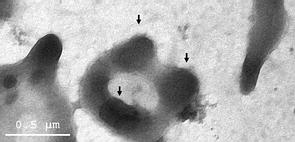
Mycoplasma
pulmonis : picture kindly provided by Dr. Warren L. Simmons
and Dr. Kevin Dybvig, Department of Genetics, University of Alabama
at Birmingham (USA) |
The reduction in size of mycoplasmal genomes is thought to be related
to the life style of these bacteria, in close contact with their
host. They are either commensals or pathogens, some of which
arefacultative intracellular parasites. They are found in both animals
(including humans and insects) and plants (Spiroplasmas and
Phytoplasmas). The adoption of an parasitic life style, based on
harnessing of the resources of the host cell, means that numerous
metabolic functions are no longer needed. Mycoplasmas synthesize
indeed few precursors de novo, and the loss of genes for
numerous biosynthetic pathways has been noted in the genomes of the
mycoplasmas that have been sequenced to date. The majority of
mycoplasmas have less than 1000 genes. M. pulmonis, for
example, has only 782 genes, compared with 4,100 for the related
firmicute bacterium Bacillus subtilis. The loss of the cell
wall may also be related to intracellular endoparasitism.
The mycoplasmas, most of which are host-specific, cause chronic
diseases with slow progression in humans and animals. Human
mycoplasmoses are found in diverse diseases of the respiratory and
urogenital tracts. Mycoplasmoses which affect farm animals cause
considerable economic loss. Antibiotic treatment often fails to
eradicate these bacteria. As for other pathogens, it is hoped that the
availability of complete genomic sequences will lead to a better
understanding of the physiology, pathogenic potential and host
specificity of mycoplasmas, and to the development of new prevention
and treatment strategies. The large number of sequenced genomes from
mycoplasma species makes comparative genomics strategies especially
valuable for the prediction of pathogenicity regions and for the
comprehension of the evolution of a very diverse group (in terms of
pathogenicity, host specificity and also morphology and nutritional
requirements). The Molligen database,
which is maintained at the CBiB (Bordeaux 2 University), is dedicated
to the comparative genomics of mycoplasmas.
Up
Description of Mycoplasma pulmonis
Murine respiratory mycoplasmosis (MRM) caused by Mycoplasma
pulmonis is one the most important pathologies for laboratory rats
and mice. Although this mycoplasmosis may remain clinically silent,
this slow-progressing illness has impaired numerous experimental
data. MRM is influenced by several factors including environment, host
(species and genetic background) and M. pulmonis strain. The
M. pulmonis experimental infection is considered as a good
model for the development of vaccines. In addition to MRM,
M. pulmonis causes genital infections which are associated with
a decreased fertility; for this reason it is also a model for the
study of intra-uterine infections.
MRM is comparable to the pathological manifestations
of M. pneumoniae infections in humans and of other animal
respiratory mycoplasmoses. M. pneumoniae is an important human
pathogen and mycoplasmoses among farm animals are responsible for
considerable economic losses. M. pneumoniae and
M. pulmonis belong to distinct phylogenetic groups :
M. pneumoniae is more closely related to M. genitalium,
M. penetrans and U. parvum (among species whose genome is
sequenced), whereas M. pulmonis belongs to the M.
hominis group, with ruminant livestock pathogens
M. bovis and M.
agalactiae.
The complete genome sequence of M. pulmonis should contribute to a better understanding of:
- mycoplasma evolution by comparison of mycoplasma genomes between themselves and with other microbial genomes. This comparison should help to define the set of genes of a minimal cell.
- MRM pathophysiology: a better knowledge of this mycoplasma genome should help to identify genes potentially implicated in virulence and to define their roles;
- the definition of host-specific genes by comparison with the genome of other mycoplasmas;
- the factors which control and influence M. pulmonis genome plasticity;
- the identification of protective antigens for the development of a vaccine against MRM with potential applications for other mycoplasmoses.
Up
A review on the molecular biology and mycoplasma pathogenicity:
Razin S., Yogev D., Naot Y. Microbiology and Molecular Biological Reviews 1998;62:1094-1156.
Results from this project have been published : Chambaud, I., R. Heilig, S. Ferris, V. Barbe, D. Samson, F. Galisson, I. Moszer, K. Dybvig, H. Wroblewski, A. Viari, E.P.C. Rocha, and A. Blanchard. The complete genome sequence of the murine respiratory pathogen Mycoplasma pulmonis. Nucleic Acids Research 2001;29(10):2145-2153..
References for the 10 other mycoplasma species which have been sequenced. As of Spring 2005, the sequencing of 16 other mycoplasmal genomes is in progress: those of M. agalactiae, M. alligatoris, M. arthritidis, M. bovis, M. capricolum, M. fermentans, M. haemofelis, M. hominis, M. orale, M. synoviae, Spiroplasma citri, S. kunkelii, as well as four Phytoplasmas.
- Mycoplasma gallisepticum strain Rlow
(chronic respiratory disease in chickens, infectious sinusitis in turkeys)
(L. Papazisi et al., Microbiology (2003) 149: 2307-2316)
- Mycoplasma genitalium G-37
(human mucous membranes)
(C.M. Fraser et al., Science (1995) 270: 397-403)
- Mycoplasma hyopneumoniae strain 232
(this mycoplasmosis causes a respiratory disease in pigs)
(F.C. Minion et al., J. Bacteriol. (2004) 186:7123-33)
- Mycoplasma mobile
(isolated from the tench, a fresh-water fish)
(J.D. Jaffe et al., Genome Res. (2004) 14:1447-1461)
- Mycoplasma mycoides subsp. mycoides SC strain PG1T
(causes contagious bovine pleuropneumonia (CBPP), a highly contagious respiratory disease that takes an heavy toll of subsaharian cattle)
(J. Westberg et al., Genome Res. (2004) 14:221-227)
- Mycoplasma penetrans HF-2
(human respiratory and urogenital tracts)
(Y. Sasaki et al., Nucleic Acids Res. (2002) 30: 5293-5300)
- Mycoplasma pneumoniae M129
(human mucous membranes)
(R. Himmelreich et al., Nucleic Acids Res. (1996) 24: 4420-4449)
- Mesoplasma florum L1
(no pathogenicity, found on citrus flowers)
(web page in Broad Institute)
- Ureaplasma urealyticum (parvum) sv 3
(human mucous membranes)
(J.I. Glass et al., Nature (2000) 407: 757-62)
- Phytoplasma asteris OY-M
(phytoplasmas infect plants)
(K. Oshima et al., Nature Genet. (2004) 36:27-9)
|





 home |
overview |
resources |
sequencing |
news |
press releases |
site |
Legal information

