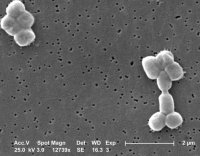
Electron micrograph of Acinetobacter baumannii (Source: Centers for Disease Control and Prevention ; Wikimedia) |
Acinetobacter
baumannii is a non-fermentative Gram-negative bacterium that has
emerged as an important pathogen responsible for serious infections
and nosocomial outbreaks in Europe and the USA. However, the
ecological origin of A. baumannii remains unknown and it is
not a common member of the normal human bacterial
flora. A. baumannii is part of a complex of species that also
includes the soil bacterium Acinetobacter calcoaceticus. This
complex is referred to as the A. calcoaceticus-A. baumannii
(ACB) complex.
In a previous collaboration with Genoscope,
Fournier et al. [1] identified the largest known 86-kb
resistance island in the genome of an epidemic MDR
A. baumannii with a 26% mortality rate.
The present study aims at exploring the generality of this finding,
and better understand the remarkable ability of A. baumanni
to rapidly acquire multiple resistances to antibiotics and antiseptics
in hospital environments. This project is coordinated by the
Structural and Genomic Information laboratory (Prof. J-M Claverie,
Marseille, France) and associates 3 clinical microbiology laboratories
(Prof. P. Normann, Le-Kremlin-Bicêtre, France ; Prof. Harald Seifert,
Köln, Germany; Prof. J. Vila, Barcelona, Spain) responsible for the
strains isolation and choice.
Reference:
[1] Fournier PE, Vallenet D, Barbe V, Audic S, Ogata H, Poirel L, Richet H, Robert C, Mangenot S,
Abergel C, Nordmann P, Weissenbach J, Raoult D, Claverie JM. (2006)
Comparative Genomics of Multidrug Resistance in Acinetobacter baumannii.
PLoS Genet. 13: e7
|





 home |
overview |
resources |
sequencing |
news |
press releases |
site |
Legal information

