| -> Access to sequencing project |
|
|
|
For more information
 Look at maps showing the global
distribution of Ralstonia solanacearum strains,
according to their parasitic specificities : race 1 (wide host range), race 2
(specific of banana tree) and race 3 (most
adapted to potato).
|
|
|
|
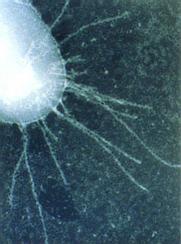
Micrography of R. solanacearum |
The comprehension of
the molecular mechanisms which give a pathogenic
bacterium the ability to invade, colonize and reorient
the physiopathology of its host is a goal of primary
importance, from both academic and medical or agronomic
points of view: such studies may direct the conception of
new strategies to fight these pathogenic agents. The
bacterium Ralstonia solanacearum is a widely
accepted model organism for the study of pathogenicity in
plants. This soil-borne bacterium, which belongs to the
group of beta-proteobacteria, is responsible for
bacterial wilts on more than 200 plant species from 50
botanical families. Several of the susceptible plants,
such as potato (in which the disease caused by the
infection is called brown rot), tomato, eggplant, pepper,
tobacco and banana tree, are of prime agro-industrial
importance. R. solanacearum in present in all the
tropical and subtropical regions of the globe; recently
there has been dissemination of strains with an optimal
growth temperature corresponding to the temperate zones
of Europe and the United States.
The study of R. solanacearum is complementary to that of the
other phytopathogenic model bacteria Pseudomonas syringae,
Xanthomonas
campestris and Xanthomonas
citri. These three species attack the aerial parts of the
plant, whereas R. solanacearum, which is capable of living for
prolonged periods in the soil, infects its hosts beginning with the
root system and presents a very strong tropism for the xylem
vessels. Its extensive multiplication in the water-conducting system
leads to a systemic infection of the plant.
A comparison of the sequences of a group of genes -including 16S
RNA- has revealed that the R. solanacearum species can be classified
into four large evolutionary clades. The strains within a same clade
can exhibit major differences in parasitic specificity. This makes
R. solanacearum an excellent model for studying the
determinants of parasitic specificity as well as the evolutionary
mechanisms which have led to the emergence of pathogenicity. This
latter research theme will also benefit from the knowledge of the
genome of Ralstonia metallidurans, a bacterium which is
taxonomically close to R. solanacearum, but is non-pathogenic
and for which a draft
genome sequence was assembled in 2003 by the Joint Genome
Institute (Walnut Creek, California).

Colonies of R. solanacearum on a Petri dish |
For a first exploration of the genome of R. solanacearum, Christian
Boucher’s group at the Laboratoire Interactions
Plantes-Microorganisms (LIPM, mixed CNRS/INRA unit) selected the
GMI1000 strain. This strain, which was isolated in Guyana from a
withered tomato plant, belongs to the Asiatic clade and has a wide
host range. Furthermore, it can infect the model plant, Arabidopsis
thaliana, whose genome has been entirely sequenced. This ability
offers the possibility of studying host responses at the genomic
scale. The genomic sequence of GMI1000 which was assembled at
Genoscope has been annotated by C. Boucher’s group. It is 5.8 Mb long
and is organized in two replicons, a chromosome of 3.7 Mb and a
megaplasmid of 2.1 Mb.
The annotation work has led to the identification of numerous
candidate genes for pathogenesis, including structural genes for more
than 50 so-called "effector" proteins. Some of these proteins
act by perturbing the metabolism of the plant cell, whereas others
suppress the defense reactions of the plant. The effectors are
injected by the bacterium into the plant cell using a type III
secretion system, whose components had been characterized before
sequencing. Among other factors of pathogenesis identified during the
annotation are several lytic enzymes, enzymes which control the
production of plant hormones and numerous factors implicated in cell
adherence. This work, which was published in
January 2002, also presented evidence for the type of role
horizontal genetic transfer could play in the acquisition of
pathogenicity.
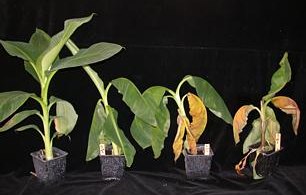
Evolution of the disease on a banana tree
infected by the Molk2 strain |
The genomic sequence of GMI1000 only presents a small part of the
genetic diversity of R. solanacearum, as shown by a sampling of
the genome of another strain. Almost 100 kb from the genome of the
strain Molk2, which belongs to the American clade and is strictly
limited to the banana tree, were sequenced at random. Comparison of
the sequences indicates that up to 30% of the genome of Molk2 is
absent in the genome of GMI1000. This observation has justified the
launching of a new sequencing project at Genoscope in 2004, in
collaboration with C. Boucher’s team. The objective is to obtain a
"draft" of the genomic sequence of two new strains, Molk2 and
1609. Like Molk2, this latter strain belongs to the American clade,
but differs in that it does not attack banana trees, and in that it is
especially well-adapted to the potato. The 1609 strain is considered
to be the type strain for strains introduced in Europe.
The research in progress today is mainly oriented toward functional
analysis of the effectors and the characterization of their molecular
targets in the plant cell. The sequencing of two additional strains
will create a new research axis: the analysis of determinants of
parasitic specificity. This work will utilize a pangenomic chip from
GMI1000 which is available today. The capacity of this chip will soon
be extended with new genes which will be identified in the genomic
sequences of the Molk2 and 1609 strains. Thus increased, the chip will
enable correlations between genes present and expressed in about 50
strains of R. solanacearum ( collection maintained at LIPM) and
the nature of plant hosts which can be infected by these
strains. Using the data obtained in this way, C. Boucher’s team will
try to develop a molecular tool which will make it possible to rapidly
evaluate the infectious potential of any new R. solanacearum
strain.
M. Salanoubat et al. (2002), Genome sequence of the plant pathogen Ralstonia solanacearum, Nature 415, 497-502.
|





 home |
overview |
resources |
sequencing |
news |
press releases |
site |
Legal information

