| -> Access to sequencing project |
|
Collaboration
 Université de Caen, IBFA, UMR Ifremer M100 Caen / Brest "Physiologie et Ecophysiologie des Mollusques Marins" - Laboratoire Ifremer "Génétique et Pathologie", La Tremblade
- Université Montpellier II, UMR Ecolag, Ifremer/CNRS/: Equipe "Réponse Immunitaire -Aquaculture-Environnement"
- Université de Bretagne Occidentale, UMR CNRS 6539 "Laboratoire des Sciences de l'Environnement Marin "
- Station biologique de Concarneau, UMR 5178 CNRS-Museum-Paris VI,: "Ecogénétique et Phylogéographie"
- Université de Provence, Marseille, EA 3781 Equipe "Phylogénomique"
- IFREMER
|
|
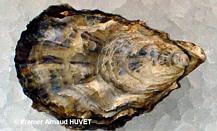
Crassostrea gigas |
The oyster
Crassostrea gigas has wide geographic distribution and, for
many years, represents the highest annual production of any aquatic
organism. The economic importance of oysters motivates a great deal of
biological research, which provides the most immediate scientific
rationales for sequencing ESTs. Strong rationales also come from
membership of oyster to the Lophotrochozoa, an understudied branch of
bilaterian animals with limited molecular data today. With high
fecundity and concomitantly high DNA polymorphism, this species also
constitutes a good model for population and genetic studies. Finally,
oysters play an important sentinel role in estuarine and coastal
marine habitats, where increasing human activities interfere with
exploited populations that may suffer from mortality related to
diseases and stress.
The C. gigas EST sequences generated by the
Genoscope will:
- help identify, in a much straightforward way, new pertinent key genes for functional purposes (physiology of growth, reproduction and development, immunity). Those will provide new tools to improve this species by genetic selection.
- be used for evolutionary studies by comparison with orthologous sequences from other mollusc species, other Lophotrochozoans or other bilaterian animals.
- complement an initial 9059 unigene microarray currentlyavailable. The resulting microarray will be more representative of the whole transcriptome and therefore extremely useful in transcriptomic programs for investigating global gene expression changes. This should help deliver a more integrative picture of the gene networks activated in the context of particular ecophysiological constrains (either in controlled conditions or in the field) and help reveal major gene networks contributing to a given physiological process under study.
- be used to identify SNPs for further genetic studies in both experimental and field populations, for population genetic and mapping studies.
- be used for recognition of haemocyte tags produced by SAGE technology.
- help to boost the sequencing of whole genome, as currently proposed by an international consortium.
|
|





 home |
overview |
resources |
sequencing |
news |
press releases |
site |
Legal information

