| -> Access to sequencing project |
|
Collaboration
 Physiologische Chemie I, Biozentrum,
Université de Würzburg
Würzburg, Allemagne.- Service de Systématique Moléculaire
Département Systématique et Evolution
Museum
National d'Histoire Naturelle, CNRS IFR 101
Paris, France.
|
|
|
|
Introduction
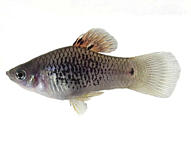
The platyfish Xiphophorus maculatus (photo
courtesy of Manfred Schartl, Würzburg) |
Xiphophorus
is a freshwater fish genus belonging to the family
Poeciliidae like the guppies (Poecilia reticulata)
and mollies (Poecilia latipinna). The name
Xiphophorus itself derives from the Greek words xiphos (sword)
and phoros (bearer). Xiphophorus includes 23 species that
live in eastern drainages in Mexico, Guatemala, Belize and Honduras
and are classified into Northern swordtails, Southern swordtails and
platyfishes. Xiphophorus are live-bearers, meaning that
females retain the eggs inside the body and give birth to live,
free-swimming young fishes. More precisely, Xiphophorus is
ovoviviparous: while eggs are retained inside the body of the female
for protection, they are essentially independent of the mother and she
does not provide them with any nutrients. Xiphophorus is very
popular (the definition of Xiphophorus
by P. Desproges) and commonly reared by aquarium hobbyists.
Hereditary melanoma and sex-chromosomal cancer genes
in Xiphophorus
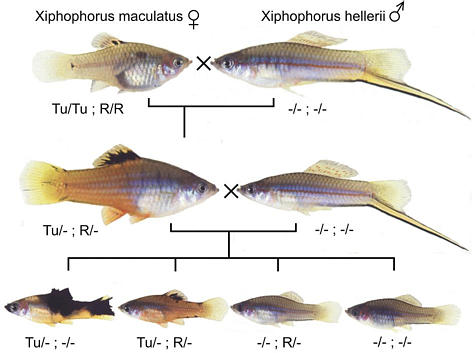
Fig2.: Crossing scheme showing the segregation of Tu (tumour locus) and R (regulatory locus) in Xiphophorus interspecific hybrids. The crossing depicted here is the so-called "Gordon-Kosswig" model, where the platyfish X. maculatus and the swordtail X. hellerii are used as parental fishes. |
Melanoma are among the most aggressive forms of human cancer. In the
1920's, it was realized by scientists in Germany and the USA that
melanoma can occur without any exogenous treatment in Xiphophorus
simply by crossing different species, for example the platyfish
Xiphophorus maculatus and the swordtail Xiphophorus
hellerii (Fig. 2). These melanomas are derived from dysregulated
melanin-producing pigment cells called the
macromelanophores. Subsequently, Xiphophorus became a
well-established model for the study of hereditary cancer.
In Xiphophorus, melanoma development is induced by generating
a regulatory imbalance between a dominant sex chromosomal
tumour-inducing locus (Tu) and an autosomal Tu-repressing regulatory
locus (R), which are present in the platyfish but absent from the
swordtail. The presence of R and Tu on different chromosomes allow for
their separation through selective breeding. When
X. maculatus is crossed with X. hellerii, the F1
progeny is heterozygous for both R and Tu. Further crossing of F1
animals with X. hellerii produces 25% offspring heterozygous
for the Tu locus, but devoid of R. In this situation, Tu is out of
control in pigment cells, where it is overexpressed and performs its
oncogenic function. This results in the formation of highly malignant,
invasive and exophytic melanomas, which are generally fatal to the
fish.
Xmrk, the gene responsible for tumour development at the Tu locus,
encodes a subclass I receptor tyrosine kinase belonging to the
epidermal growth factor receptor (Egfr) family (Wittbrodt et al. 1989,
Nature 341:415). The Xmrk oncogene was generated through duplication
of the egfrb proto-oncogene early during the evolution of the genus
Xiphophorus (Adam et al. 1993, Science 259:816). Compared to
its proto-oncogenic counterpart, Xmrk displays a completely new
transcriptional regulation as well as activating mutations conferring
a ligand-independent constitutive activity to the receptor. Xmrk and
egfrb are located in the subtelomeric region of the sex chromosomes of
X. maculatus. Both genes are closely linked to the master
sex-determining gene SD of the platyfish on the X and Y
chromosomes. Xmrk is potentially hazardous, non-essential and located
in a very unstable genomic region. Nevertheless, Xmrk has been
maintained functional in divergent Xiphophorus species. Hence, Xmrk
has probably a beneficial function under certain conditions. The
analysis of this function is a major challenge for future research in
the Xiphophorus model.
Another sex-chromosomal locus of high relevance for the formation of
melanoma in Xiphophorus is Mdl, the
macromelanophore-determining locus. Macromelanophores are large
melanin-containing cells that produce highly polymorphic pigment
patterns. They are the cellular progenitors of Xmrk-induced
melanomas. Mdl determines not only the phenotype of macromelanophore
patterns, but also, probably in combination with Xmrk, the location,
onset and malignancy of melanoma. Therefore, Mdl can be defined as a
tumour modifier. Mdl is intimately linked to Xmrk but has not been
identified so far at the molecular level.
Evolution of sex determination in
vertebrates: the model Xiphophorus
The molecular basis of sex determination and gonad differentiation is
poorly understood in non-mammalian vertebrates, and even in human
important members of the sex-determining cascade are still to be
identified. The Y-chromosomal gene Sry, inducing the male phenotype in
human and mouse, has been formed during the evolution of mammals and
is absent from other vertebrate lineages. The mammalian Y chromosome
is losing its genes; this ongoing process might lead to the loss of
the Y chromosome and to the extinction of Homo sapiens. Investigation
of sex determination mechanisms in non-mammalian vertebrate models
might help to predict the future of sex determination in human and to
discover alternative sex-determining systems able to substitute for
the current Sry-dependent pathway.
Fish are attractive models to study sex determination, particularly
because they have developed an amazing diversity of environmental and
genetic strategies to establish sexual dimorphism. No simple model of
genetic sex determination can be generalized in fish. Both male
(XX/XY) and female heterogamety (ZZ/ZW) has been observed, as well as
more complicated situations involving multiple sex chromosomes,
polygenic sex determination and autosomal modifiers. Furthermore,
gonadal sex differentiation can be strongly influenced in some fishes
by environmental factors including temperature, pH or fish
density. Sex inversion can be obtained in several fish species
spontaneously or after treatment by steroid hormones. Almost nothing
is known about the molecular and evolutionary mechanisms driving the
variability of sex determination. This phenomenon might play a role in
speciation in fish.
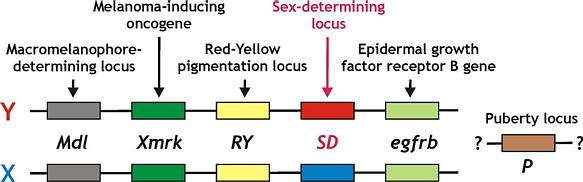
Fig3.: Genes and gene loci linked to the master sex-determining gene SD on the sex chromosomes of the platyfish Xiphophorus maculatus. |
Importantly, molecular sexing and manipulation of sex determination in
fish are key economical challenges for the aquaculture. The necessity
of the control of reproduction to avoid overcrowding, as well as the
presence of sex-specific differences in fish growth, quality and
behavior make monosex populations generally highly desirable in fish
farming (all-male or all-female populations, depending on the
species). Monosex populations can be generated after treatment of one
of the parents with estrogens or androgens. The development of
molecular tests to determine routinely the sex of individuals at early
stages of development could allow the early selection of breeders of a
chosen genotype necessary for the production of such monosex
populations, and the rapid analysis of products in breeding,
androgenesis and gynogenesis experiments.
Almost no information is available concerning sex determination
mechanisms in most fishes, and neither sex-linked molecular markers
nor sex chromosomes are identifiable in the classical fish models, the
zebrafish Danio rerio and the pufferfishes Takifugu rubripes
(Fugu) and Tetraodon nigroviridis. The master
sex-determining gene dmrt1bY of the medaka Oryzias latipes is
present only in a very restricted number of species, and is therefore
not the ubiquitous sex-determining gene in fish (Matsuda et al. 2002,
Nature 417:559; Nanda et al. 2002, Proc Natl Acad Sci USA 2002,
99:11778). Therefore, alternative models are needed to identify the
master sex-determining gene(s) in more than 23.000 fish species.
The platyfish Xiphophorus maculatus is an ideal model to
perform the positional cloning of a master sex-determining (SD)
gene. In this fish, SD is located between two genes, the
melanoma-inducing oncogene Xmrk and its proto-oncogenic duplicate
egfrb, which are both already characterized at the molecular
level. This situation should allow the identification of the master
sex-determining gene of the platyfish by a positional cloning
strategy. SD is also closely linked to loci involved in pigmentation
and/or melanoma phenotype (Mdl and RY, for "red-yellow" locus) and in
the onset of sexual maturity (P, for "puberty") (Fig. 3). The
identification of these genetic loci, also aim of the project, is
highly relevant for both cancer research and aquaculture.
Definition of Xiphophorus according to Pierre Desproges (in French)
Xiphophore (n.m.): Le xiphophore est un petit poisson de coloration
variée, de six à dix centimètres de long et originaire du Mexique. Au
moment de se reproduire, le xiphophore émet un cri strident:
Christiane! pour appeler la xiphophorette qui accourt bientôt ventre à
flotte, la caudale en feu. S'ensuit alors une danse d'amour effrénée
dont le tendre spectacle ne peut que toucher le coeur de tout homme
capable de supporter un documentaire écologique marin sans balancer
ensuite une grenade offensive dans le lac d'Enghien (Dictionnaire
superflu à l'usage de l'élite et des bien nantis, 1985).
References
- Froschauer A, Korting C, Bernhardt W, Nanda I, Schmid M,
Schartl M, Volff JN (2001) Genomic plasticity and melanoma
formation in the fish Xiphophorus. Mar Biotechnol (NY) 3
(Supplement 1): S72-S80.
- Meierjohann S, Schartl M, Volff JN (2004) Genetic, biochemical
and evolutionary facets of Xmrk-induced melanoma formation in the
fish Xiphophorus. Comp Biochem Physiol C Toxicol
Pharmacol 138: 281-289.
- Schultheis C, Zhou Q, Froschauer A, Nanda I, Schmidt C, Naciri
M, Selz Y, Matschl S, Wenning M, Veith AM, Braasch I, Böhne A,
Dettai A, Ozouf-Costaz C, Segurens B, Couloux A, Bernard-Samain S,
Schmid M, Schartl M, Volff JN (2006) Molecular analysis of the
sex-determining region of the platyfish Xiphophorus
maculatus. Zebrafish (sous presse).
- Volff JN (2005) Genome evolution and biodiversity in teleost
fish. Heredity 94: 280-294.
- Volff JN, Schartl M (2001) Variability of genetic sex
determination in poeciliid fishes. Genetica 111: 101-110.
- Volff JN, Schartl M (2002) Sex determination and sex
chromosome evolution in the medaka, Oryzias latipes, and the
platyfish, Xiphophorus maculatus. Cytogenet Genome Res
99: 170-177.
|





 home |
overview |
resources |
sequencing |
news |
press releases |
site |
Legal information

