| -> Access to sequencing project |
|
Collaboration
 Laboratoire d'Ecologie Microbienne de la
Rhizosphère (LEMIR)
UMR 6191, CNRS-CEA-Université de la Méditerranée
DEVM, CEA Cadarache
Saint Paul Lez Durance, France- Institut de Génétique et Microbiologie
Université Paris-Sud
Orsay, France
|
|
For most living
organisms, a few DNA double-strand breaks generated by ionizing
radiation are lethal. However, bacteria belonging to the genus
Deinococcus are known for being very tolerant to high doses
of ionizing radiation. This tolerance is related to the capacity to
efficiently repair massive DNA lesions, including hundreds of
double-strand breaks. It should be noted that natural sources of
ionizing radiation on Earth exist at levels much lower than those used
to generate large numbers of double-strand breaks, suggesting that
radiation tolerance is a consequence of the bacterial response to
natural non-radioactive DNA damaging conditions such as
desiccation. Indeed, Deinococcus bacteria are not only
extremely resistant to gamma radiation but also to desiccation and UV
radiation.
Deinococcus radiodurans R1
Of the Deinococcus species, only Deinococcus
radiodurans strain R1 has been extensively studied. High doses of
gamma radiation, as well as prolonged periods of desiccation, generate
numerous double-strand breaks in the genome of
D. radiodurans. It has been shown that
D. radiodurans is able to repair the radiation-induced breaks
within a few hours with cells grown and recovered in rich growth
medium. The genome of D. radiodurans R1 has been completely
sequenced and analyzed (Makarova et al., 2001, Microbiol Mol Biol Rev
65: 44), and the effects of exposure of the cells to gamma radiation
on the transcriptome and proteome have been determined, demonstrating
modulation of expression of numerous genes. Based on what is known at
present, three hypotheses to explain its radiation-tolerance can be
proposed:
- D. radiodurans may use conventionnel repair
mechanisms, but much more efficiently than other bacteria;
- novel repair proteins may be present among the hypothetical
proteins of which the function is currently unknown;
- the DNA is present as a highy condensed structure that limits
dispersion of fragments generated by irradiation, which may
facilitate repair.
Despite these hypotheses, the genome repair mechanisms of
D. radiodurans, and thus its extreme radiation-tolerance, are
still largely unclear (Cox & Battista, 2005, Nat Rev Microbiol 3:
882).
Deinococcus deserti VCD115
A comparative genomic analysis of D. radiodurans with a
related species will likely improve our comprehension of the
mechanisms involved in the extreme radiation tolerance in
Deinococcus. For this analysis, Deinococcus deserti
strain VCD115 has been selected. D. deserti, recently
isolated from the Sahara desert, does not grow in rich media in
contrast to D. radiodurans (de Groot et al., 2005, Int J Syst
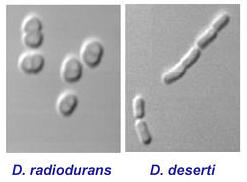
Evol Microbiol 55 : 2441). D. deserti cells are non-motile
rods, whereas those of D. radiodurans are spherical. In
contrast to the red or pink colonies of other Deinococcus
species, those of D. deserti are whitish. D. deserti
stains Gram-negative, whereas D. radiodurans stains
Gram-positive. The genome size of D deserti VCD115 has been
estimated at 3.8 Mb, whereas the sequenced D. radiodurans
genome is 3.2 Mb. We have shown that D. deserti VCD115 is
very tolerant to gamma and UV radiation, as well as to desiccation (de
Groot et al., submitted). Exposure of D. deserti to a high
dosis of gamma radiation results in the fragmentation of its genome
(double-strand breaks), but D. deserti has the capacity to
repair it within a few hours when incubated in poor growth medium.
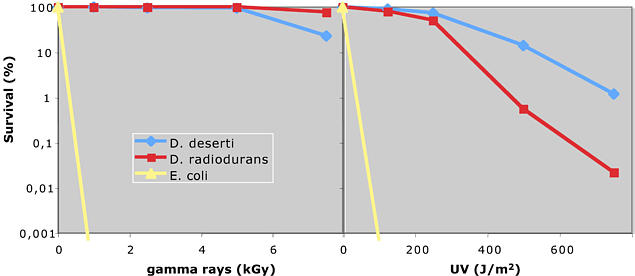
Resistance to gamma and UV radiations |
Sequencing of the genome of D. deserti VCD115
For a better understanding of the extreme radiation-tolerance in
Deinococcus, D. deserti will be compared to
D. radiodurans, starting with the genomic approach, then with
other global (transcriptome and proteome) and targeted approaches
(genetics, biochemical, structural). For this comparative study,
sequencing of the genome of D. deserti VCD115 is in
progress. With the D. deserti genome sequence, it will be
possible to determine:
- the genes that D. deserti and
D. radiodurans have in common,
- the differences with the genomes of radiation-sensitive
bacteria,
- and the genes unique in VCD115.
The comparative and functional analysis should allow us to improve our
comprehension of the mechanisms implicated in DNA repair and the
extraordinary resistance to gamma and UV radiation and to desiccation.
|





 home |
overview |
resources |
sequencing |
news |
press releases |
site |
Legal information

