
Silene
acaulis infected by Microbotryum
violaceum. Purple spores are produced in anthers (Photo by Michael Hood). |
The anther-smut
fungus Microbotryum violaceum (formerly Ustilago
violacea) is a basidiomycete obligate parasite of many
Caryophyllaceae. In an infected plant, the fungus produces teliospores
in the place of pollen (in dioecious plant species, infected females
develop spore-bearing anthers and ovaries are aborted). The disease
sterilizes but does not kill its host plant. Teliospores are the
dispersing form of M. violaceum : they are transported
from diseased to healthy plants by insects that usually serve as
pollinators for the host plant. Once deposited on a host plant,
diploid teliospores undergo meiosis and give rise to four haploid
cells. Each of these cells buds off yeast-like sporidia locally on the
plant surface. New infectious dicaryons are rapidly produced by
conjugation of two cells of opposite mating-type. Dicaryotic hyphae
then enter the host tissue and grow endophytically. If the fungus
manages to reach the rootstock before winter, the plant may become
systemically infected and produce only diseased flowers in subsequent
years. Recovery from disease is rare.

Silene
latifolia infected by Microbotryum
violaceum. Purple spores are produced in anthers (Photo by
Michael Hood). |
A multiple gene genealogies approach identified several cryptic
species within M. violaceum, corresponding to lineages highly
specialized on different plant species, isolated for several millions
years. The phylogenies of the fungi and the host plants are not
congruent, indicating that cospeciation did not occur. The different
cryptic species of M. violaceum are isolated by a strong
post-zygotic barrier : crosses can be obtained in vitro, but most
hybrids are not viable.
Search for adaptive genes under
positive selection Microbotryum violaceum
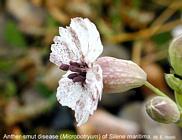
Silene
maritima infected by Microbotryum
violaceum. Purple spores are produced in anthers (Photo by
Michael Hood). |
cDNA libraries from different sibling species of the complex
M. violaceum will be sequenced. The comparison between
homologous genes from the different species will allow identifying
genes under positive selection, i.e. which evolution has been rapid
and different among the sibling species specialized on different host
plants. These genes are expected to have important roles in speciation
(species formation) and adaptation of the fungus to the host
plant. This project will bring insights into the molecular and
evolutionary mechanisms of speciation and adaptation in pathogens,
which will have important theoretical and applied consequences, for
instance for the understanding of disease emergence in crops and
humans and more broadly in medicine.
|





 home |
overview |
resources |
sequencing |
news |
press releases |
site |
Legal information

