Taxonomy
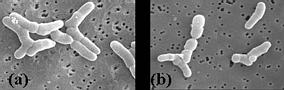
Morphology of Propionibacterium freudenreichii under standard conditions (a), and under conditions of acid stress (b). Scanning electron micrograph (Photo INRA) |
Propionibacteria are gram-positive, non-motile, non-spore forming,
anaerobic to aerotolerant, pleomorphic rods (coccoid, bifid or
branched) and mesophilic bacteria. They belong to the class of
Actinobacteria (high GC content), and the order of
Actinomycetales. The genus Propionibacterium is divided in
"cutaneous" and "dairy" propionibacteria. The sequenced strain is
Propionibacterium freudenreichii ssp. shermanii type strain
CIP 103027 and have a circular chromosome of about 2.5 Mb (Gautier et al. 1992) and 67 % GC content. This strain belongs to dairy bacteria, growth most rapidly at 30 °C under anaerobic conditions and form cream colony on yeast-extract lactate agar medium in 5-6 days.
Natural habitat
Dairy propionibacteria are commonly found in milk and dairy products,
but have also been isolated from soil, silage, brines for olive
fermentation and rum distilleries (Cummins &
Johnson, 1986).
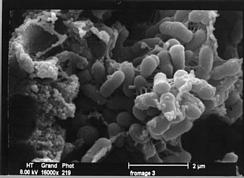
Propioibacterium freudenreichii in Emmental cheese (Photo INRA) |
Activities in cheese
Propionibacterium freudenreichii is essential as ripening
starter in Emmental (Swiss-type) cheese manufacture. Propionibacteria
grow during the ripening in the "warm" room (24°C), and ferment
lactate to acetate, propionate and CO2 with an original metabolism (Meurice et al. 2004). Propionate and acetate
contribute to the nutty and sweet flavour of the cheese, whereas CO2
is at the origin of the formation of the characteristic eyes of this
type of cheeses (Langsrud & Reinbold,
1973). Their involvement in protein breakdown is low compared with
that of the lactic acid bacteria used as starters (Gagnaire et al. 2001). In contrast,
P. freudenreichii plays an important role in the formation of
vaired flavour compounds: free fatty acids derived from lipolysis and
branched-chain compounds derived from isoleucine and leucine
catabolism (Thierry et al., 2005). The
lipolytic activity of propionibacteria is about 100- fold higher than
that of the lactic acid bacteria (Dupuis et al.,
1993). Propionibacteria lipase(s) and esterase(s) are a focus of
the microbiology team of UMR STLO.
Probiotic activities
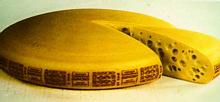
Emmental cheese, which is first in France in terms of production, about 250,000 tons per year. There are one billion living cells of Propionibacterium freudenreichii per gram of cheese (Photo INRA) |
There is a recent and growing interest in the probiotic potential of
these bacteria. In addition to production of B12 vitamin and
inhibition of undesirable microflora in fermented food via the release
of organic acids and bacteriocins, they were shown to beneficially
modulate the colon flora both in animals (Perez Chaia et al., 1999) and humans (Bougle et al., 1999), mainly by enhancing the indigenous bifidobacteria population. In cattle, they cause better exploitation of fodder and stimulate growth (Mantere-Alhonen, 1995). Interestingly, they adapt efficiently to digestive stresses (Jan et al., 2001a; Leverrier et al., 2003), stay alive in the human digestive tract (Jan et al., 2001b) and adhere to intestinal epithelial cells and to intestinal mucus (Zarate et al., 2002; Ouwehand et al., 2002). Recent data of UMR STLO suggest that dairy propionibacteria may have a role in the prevention of colon cancer. This is consistent with their ability to lower enzymatic activities involved in carcinogenesis (Perez Chaia et al., 1999) and to induce apoptosis of colorectal carcinoma cells via short-chain fatty acids acting on cancer cells mitochondria (Jan et al., 2002). UMR STLO focuses its probiotic research on this latter subject.
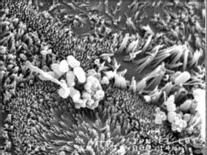
Interaction
between human colon cells in culture (Caco-2) and proprionic dairy
bacteria (Propionibacterium freudenreichii) observed under a scanning
electron microscope. (Photo INRA) |
Current and future investigations
- Genome organisation
- Complete genome annotation
- Comparative genomic with Propionibacterium acnes (cutaneous pathogenic species)
- Development of DNA microarrays
- Development of genetic tools
- Strain diversity of lipase, esterase and exopolysaccharides products, stress adaptation (bile, acid, salt, starvation) by genomic, transcriptomic and proteomic approaches.
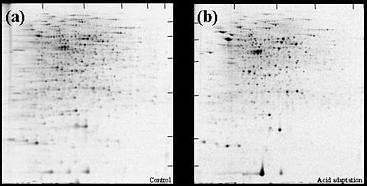
The proteome of Propionibacterium freudenreichii analyzed by electrophoresis under standard (a) and acid stress (b) conditions (Photo INRA) |
References
- Bougle D, Roland N, Lebeurrier F, Arhan P (1999) Effect of
propionibacteria supplementation on fecal
bifidobacteria and segmental colonic transit time in
healthy human subjects. Scand.J.Gastroenterol. 34:144-148
- Cummins CS and Johnson JL (1986) Genus I.
Propionibacterium Orla-Jensen 1909. Pages 1346-1353 in
Bergey's Manual of Systematic Bacteriology. P. H. A. Sneath,
N. S. Mair, M. E. Sharpe, and J. G. Holt, ed , Baltimore.
- Dupuis C, Corre C, Boyaval P (1993). Lipase and esterase
activities of Propionibacterium freudenreichii
subsp. freudenreichii. Appl. Environ. Microbiol.
59:4004-4009.
- Gagnaire V, Thierry A, Léonil J P (2001)
Propionibacteria and facultatively heterofermentative
lactobacilli weakly contribute to secondary proteolysis
of Emmental cheese. Lait. 81 339-353.
- Gautier M, de Carvalho A, Rouault A (1992). DNA fingerprinting
of dairy propionibacteria strains by pulsed-field electrophoresis.
Curr. Microbiol. 32 :17-24
- Jan G, Belzacq AS, Haouzi D, Rouault A, Metivier D, Kroemer G,
Brenner C (2002) Propionibacteria induce apoptosis of
colorectal carcinoma cells via short-chain fatty acids acting on
mitochondria. Cell Death Differ. 9:179-188
- Jan G, Leverrier P, Pichereau V, Boyaval P (2001a) Changes in
protein synthesis and morphology during acid adaptation of
Propionibacterium freudenreichii.
Appl.Environ.Microbiol. 67:2029-2036
- Jan G, Leverrier P, Roland N (2001b) Survival and beneficial
effects of propionibacteria in the human gut: in vivo and
in vitro investigations. Lait. 82:131-144
- Langsrud T and Reinbold GW (1973) Flavor development and
microbiology of Swiss cheese- A review. III. Ripening and flavor
production. J. Milk Food Technol. 36:593-609.
- Leverrier P, Dimova D, Pichereau V, Auffray Y, Boyaval P, Jan
G (2003) Susceptibility and adaptive response to bile salts in
Propionibacterium freudenreichii: physiological and
proteomic analysis. Appl.Environ.Microbiol. 69:3809-3818
- Mantere-Alhonen S (1995) Propionibacteria used as
probiotics - A review. Lait 75:447-452
- Meurice G, Jacob D, Deborde C, Chaillou S, Rouault A,
Leverrier P, Jan G, Thierry A, Maillard MB, Amet P, Lalande M,
Zagorec M, Boyaval P, Dimova D. (2004) Whole genome sequencing
project of a dairy Propionibacterium freudenreichii subsp
shermanii genome: progress and first bioinformatic analysis.
Lait. 84 :15-24.
- Ouwehand AC, Suomalainen T, Tolkko S, Salminen S (2002) In
vitro adhesion of propionic acid bacteria to human intestinal
mucus. Lait. 82:123-130
- Perez Chaia A, Zarate G, Oliver G (1999) The probiotic properties
of propionibacteria. Lait. 79:175-185
- Thierry A., Maillard MB, Richoux R., Kerjean JR, Lortal S (2005)
Propionibacterium freudenreichii strains quantitatively
affect production of volatile compounds in Swiss cheese. Lait.
85:57-74.
- Zarate G, Morata D, Chaia AP, Gonzalez SN (2002) Adhesion of
dairy propionibacteria to intestinal epithelial tissue in
vitro and in vivo. J Food Prot. 65:534-539
|





 home |
overview |
resources |
sequencing |
news |
press releases |
site |
Legal information

