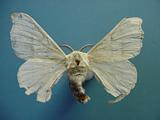
Bombyx mori |
Insects are in competition with human agro-industry. Every day, 1/6 of the world's agricultural production is consumed by insects (the majority by lepidopteran larvae), especially in those countries which are the most dependent on agriculture for their subsistance or for the revenue it generates for health and development expenses.
The Lepidoptera are the most diverse group of
animals in the world (>160,000 species) after the Coleoptera, and they
are practically all herbivores (compared with Drosophila and
Anopheles).
The diversification of the Lepidoptera followed that of the
angiosperms, about 130 million years ago. The noctuid family
(Noctuidae) is the largest in the order (>50,000 species), and
includes the most devastating pests on the planet. Helicoverpa
armigera (Helicoverpa zea in America) is found in all the major crops
(corn, sorghum, cotton soja, dry legumes) and Spodoptera frugiperda is
also found in rice, corn and cotton. The distribution of species from
these two genera (Helicoverpa and Spodoptera) covers all the
continents.
Genetically-modified plants (GMOs) protected against the lepidopterans
(cotton and Bt-corn) can reduce the use of these neurotoxic pesticides
by 80% (Huang et al., Science 295:674; 2002). However, opposition to
GMOs is increasing (Gahan et al., Science 293: 857: 2001), and may
lead to serious consequences (return to pesticide use, ruin of the
agrarian sector, etc.). It is therefore urgent to clearly understand
the molecular mechanisms of resistance to Bt and classic pesticides,
as well as the biology of the Lepidoptera and their interactions with
plants and pathogens.
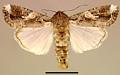
Spodoptera frugiperda |
A model insect, for which substantial genetic and
genomic resources are available, is needed for this type of
research - Bombyx. But despite phylogenetic proximity (60-90 million
years) between Bombyx and the noctuids (compared to
Drosophila/Anopheles - 250 million years;
D. melanogaster/D. pseudoobscura--46 million years), it must be shown
that Bombyx, which has been domesticated for more than 6,000 years, can
serve as a model for insect pests.
|





 INRA / CNRS
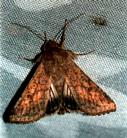
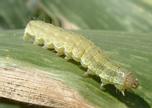
 home |
overview |
resources |
sequencing |
news |
press releases |
site |
Legal information

