| -> Access to sequencing project |
|
Collaboration
 ERT 1038 "Vaccination Antiparasitaire"
Laboratoire de Biologie Cellulaire et Moléculaire
15 Avenue Charles Flahault - BP 14491
34083 Montpellier Cedex 5, France- Equipe de Parasitologie Moléculaire et
Cellulaire
Laboratoire de Biologie des Protistes
UMR CNRS 6023
Université Blaise Pascal
63177 Aubière Cedex, France
|
|
Babesia: parasites which
develop within erythrocytes
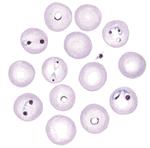
Photo Laboratoire de Biologie Cellulaire et Moléculaire |
The genus
Babesia comprises a large group of protozoans which develop
within erythrocytes. They are transmitted by tick bites and infect a
large range of vertebrates.
The taxonomic classification of these parasites is based on: i) the
demonstration of an apical complex, which places the Babesia in the
Apicomplexa lineage, ii) the absence of a conoid which positions them
in the class Aconoidasida and iii) their pear-shaped morphology
(piriform) which implies their membership in the order
Piroplasmida.
Siixty-eight species of Babesia are known to date, and at least
eighteen are pathogenic in domestic or wild animals (cattle, sheep,
goats, horses, pigs, cats, dogs, rodents) or humans. The principal
clinical signs of babesiosis are generally fever, hemolytic anemia,
and hemoglobinuria. In severe cases, the disease may progress to coma
and death.
Babesia microti, a rodent parasite which causes human babesiosis.
Because of its worldwide geographic distribution, the species most
frequently implicated in human babesiosis today is Babesia microti.
In Europe, however, B. divergens is also responsible for human
babesiosis in splenectomized patients, and unidentified species
different from B. microti and B. divergens have also been implicated
in America, Europe and Asia.
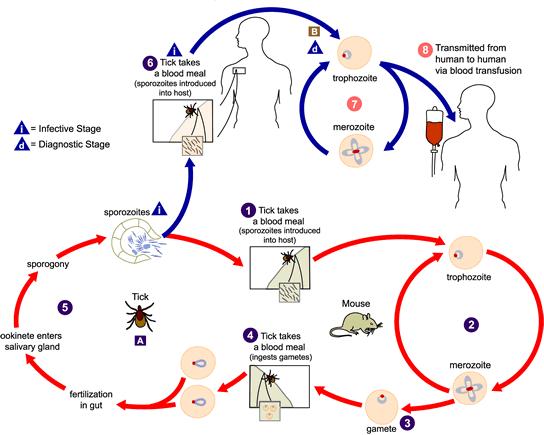
The cycle of Babesia microti involves a mammalian host and a
tick vector. During a blood meal, a tick infected by B. microti
injects sporozoites into its rodent host (1). The sporozoites
penetrate the erythrocytes and reproduce asexually by budding, leading
to the formation of 2 or 4 merozoites which initiate new
endoerythrocyte cycles (2). In the blood, some parasites differentiate
into male or female gametocytes (3). The definitive host is a tick of
the Ixodides family; once ingested by the appropriate tick (4), the
gametes undergo a sporogony cycle which leads to the formation of new
sporozoites (5).
Humans enter the cycle whey they are bitten by an infected tick (6). A
tick infected by Babesia microti injects sporozoites and an
endoerythrocytic cycle is initiated. The multiplication of the blood
stages of the parasite is responsible for the clinical manifestations
of babesiosis (7). Furthermore, human-to-human transmission via blood
transfusion is known, and has been well-documented (8).
Importance of sequencing the
genome of Babesia microti
B. microti is a Eukaryote which lends itself well to complete sequencing because of its haploid nature and its relatively small size (5.2 Mb, 3 chromosomes).
The genome of B. microti is the smallest genome described to date in
the Apicomplexes, which suggests an original genomic structure and a
minimal proteome for this parasite. The determination of this minimal
genomic organization for parasites with a complex life cycle could
lead to a definition, within the Apicomplexes, of the minimal protein
information required for an essential function.
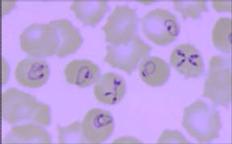
Babesia microti infecting human erythrocytes
(Photo from the site of CEMERA) |
Furthermore, despite recent studies, the precise phylogenetic
positioning of B. microti remains
uncertain. B. microti seems to belong in the ancestral group
of Archaeopiroplasmides, which gave rise to the Theilerides, Babesides
and Ungulibabesides groups. For Babesia in the strict sense, only the
genome of B. bovis (Ungulibabesides, which exclusively
parasitizes cattle) is being sequenced at the moment.
The sequencing of the genome of B. microti will provide the
first genomic resource from the family of Piroplasmides which is
pathogenic for humans. This sequencing will be of primordial utility
for the characterization of antigens implicated in a given function,
and could provide the basis for defining a vaccine and/or
chemiotherapy against human babesiosis caused by B. microti.
|





 home |
overview |
resources |
sequencing |
news |
press releases |
site |
Legal information

