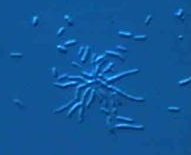
Microscopic appearance of Bradyrhizobium ORS278. The bacteria in the form of a club, have a tendency to agglutinate to form rosettes (Photo IRD). |
Bacteria of the
genus Bradyrhizobium are, like the rhizobia, capable of
inducing the formation of special organs called nodules on the roots
of plants of the legume family, in which they fix atmospheric nitrogen
in symbiosis with the plant. These symbioses play a key role in the
biologic nitrogen cycle, in agriculture, and in the renewal of
degraded soil. Research on these organisms is important for ecology,
biology and economics.
Five species of Bradyrhizobium have been described
to date, of which B. japonicum, because of its capacity to form
nodules on soja, is one of the bacteria which has been exploited
most. It genome has been completely sequenced by the Kazusa DNA Research Institute.
The photosynthetic Bradyrhizobia form a separate phylum and
may constitute a new species of Bradyrhizobium.
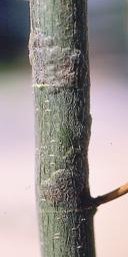
Stem nodule of
Aeschynomene sensitiva (Photo IRD) | |
| |
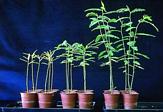
Loss of photosynthetic function during symbiosis between
Bradyrhizobium ORS278 and Aeschynomene
sensitiva (Photo IRD) | |
| |
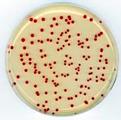
Pigmentation of Bradyrhizobium ORS278 colonies. The red-orange color is due to the production of 2 pigments: spirilloxanthine (a photosynthetic carotenoid) and canthaxanthine (the principal pigment, which represents up to 80% of the carotenoids produced)(Photo IRD). | |
They are phylogenetically close to Rhodopseudomonas palustris, a
purple bacterium whose genome has been sequenced by the DOE Joint
Genome Institute. This bacterium is known by microbiologists for its
adaptability to extremely variable environmental conditions and its
capacity to degrade several xenobiotic compounds. The photosynthetic
Bradyrhizobia, which occupy an intermediate phylogenetic
position between B. japonicum and R. palustris, are
characterized by several remarkable properties:
- The capacity to form nodules on the stems of some tropical aquatic legumes of the genus Aeschynomene. These shoot nodules may be profuse, and plants with this type of nodules have an exceptional capacity for nitrogen fixation. These legumes are utilized in some regions of Asia and Africa as green fertilizer, especially in the cultivation of rice. The ORS278 strain was isolated in Senegal from a stem nodule of Aeschynomene sensitiva in 1991.
- The ability to photosynthesize, which is a unique property in
these rhizobia. It has been shown that this photosynthetic
activity plays a key role in symbiosis: during the first stages of
the intraction with the plant by facilitating survival and
infectivity of the bacterium, and during symbiosis with the shoot
by furnishing energy which can be used for biological nitrogen
fixation. The regulatory mechanisms for the formation of this
photosystem are very different from those described in purple
bacteria. In fact, a bacteriophytochrome is involved, which, as a
function of the ambient light, triggers or fails to trigger the
expression of photosynthetic genes. This original mechanism of
regulation seems especially well adapted for promoting a specific
photosynthetic activity during symbiosis with the stem.
- The capacity to colonize the root system of rice. These
photosynthetic Bradyrhizobia are found to be naturally
associated with a wild rice species, Oryza breviligulata
which co-inhabits some tropical marshes of Africa with
Aeschynomenes. This association is very beneficial for
the growth of the plant and the production of seeds; plots
inoculated with the ORS278 strain achieve production yields which
are 20% higher.
- The capacity of some strains, and especially the ORS278
strain, to produce canthaxanthine. This carotenoid of
biotechnological interest is used in the agro-alimentary,
pharmaceutic and cosmetologic industries for its coloring and
photo-protective properties.
This sequencing project thus has as its principal
objectives: to enlarge the knowledge available in genomics of
temperate rhizobia to the tropical milieu; to contribute to the
comprehension of the mechanisms of plant/bacterial interactions
(Bradyrhizobium/rice and Bradyrhizobium/legume); to
elucidate the mechanisms of adaptation of the bacterium to different
light environments and to understand the evolution of symbiotic and
photosynthetic systems in rhizobia through comparative genome
analysis.
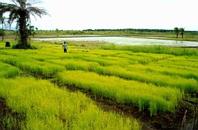
Trial inoculation of a rice paddy with Bradyrhizobium ORS278 (Conakry Guinea - Photo IRD) |
|





 LSTM Laboratoire des Symbioses Tropicales
et Méditerranéennes (UMR
 home |
overview |
resources |
sequencing |
news |
press releases |
site |
Legal information

