| -> Access to sequencing project |
|
Collaboration
 Laboratoire de Microbiologie et EA
3647
Faculté de Médecine Paris Ile-de-France Ouest
Garches, France- Laboratoire Génome et Informatique,
UMR CNRS 8116
CNRS/ Université d'Evry
Evry, France
|
|
En savoir plus
- Griffith DE. Emergence of nontuberculous mycobacteria as pathogens in cystic fibrosis. Am J Respir Crit Care Med 2003;167:810-2.
- Tortoli E. Impact of genotypic studies on mycobacterial taxonomy: the new mycobacteria of the 1990s. Clin Microbiol Rev 2003;16:319-54.
- Cullen N, Cannon CL, Mark EJ and Colin AA. Mycobacterium abscessus infection in cystic fibrosis : colonization or infection. Am J Respir Crit Care Med 2000;161:641-5.
- rown-Elliott BA, Wallace RJ Jr. Clinical and taxonomic status of pathogenic nonpigmented or late-pigmenting rapidly growing Mycobacteria. Clin. Microbiol. Rev 2002;15:716-46.
|
|
The genus
Mycobacterium belongs to the phylum Actinobacteria
(family Mycobacteriaceae) and includes species with a high
GC%. Two principal groups may be distinguished: mycobacteria which
grow slowly (slow growers) and mycobacteria which grow rapidly (rapid
growers). The latter, about 60 species reported to date, are
distinguised from the slow growers by their capacity to produce a
visible culture in a few days on ordinary medium. Other common
characteristics are living in a hydrotelluric environment, and many
are naturally multi- antibiotic-resistant.
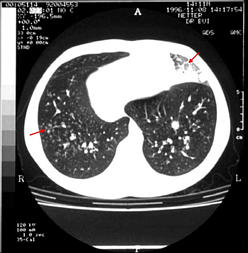
Photo 1: Pulmonary infection with M. abscessus in a patient with cystic fibrosis (high resolution tomodensitometry): centro-lobular micronodules (lower arrow) and segmentary condensation (upper arow) |
Mycobacterium abscessus and
Mycobacterium chelonae are the main rapid growers which are
pathogenic for humans, in whom they provoke a large spectrum of
infections: soft tissue infections, and infections of the locomotor
apparatus after surgery of injection of drugs, broncho-pulmonary
infections, disseminated infections in immunodeppressed subjects and
graft recipients.
Broncho-pulmonary infections due to M. abscessus which occur
in patients with cystic fibrosis (photo 1) are a particularly
important problem, and are the object of increased surveillance in
France under the auspices of the Vaincre La Mucoviscidose
Assocation. These infections are frequent--affecting up to one patient
in 20 in some centers--and affect all ages. They are severe and
especially difficult to treat because of the resistance of
M. abscessus to many antibiotics. They present a major
obstacle to lung transplantation, which often represents the only
chance of survival for some patients with cystic fibrosis.
The sequencing of M. abscessus and M. chelonae is of
interest for two reasons. The first is that this will be the first
human pathogenic rapid grower to be sequenced. The only rapid grower
for which a large amount of sequencing data is available is
Mycobacterium smegmatis (TIGR), a species which is almost
devoid of pathogenicity for humans and laboratory animals. The
sequences of M. abscessus and M. chelonae should
provide valuable information about analogies, or relationships, which
may exist between these species and the slow growing mycobacteria
which are pathogenic for humans.
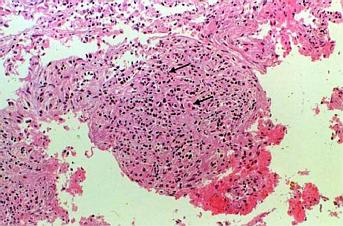
Photo 2: Bronchial granuloma caused by M. abscessus (CD3-positive). The black arrows indicate multinucleate giant cells (photo courtesy of Professor F. Jaubert, Laboratoire d'Anatomie Pathologique, Hopital Necker Enfants-Malades) |
The second reason for this interest resides in the opportunity to perform a comparative genomic analysis between M. abscessus and M. chelonae, two species which are genetically very close, and which for a long time were considered as two sub-species of the same species. Indeed, although M. abscessus and M. chelonae are both pathogenic for humans, the first is clearly different from the second in its ability to induce a disease which is similar to tuberculosis: tropism for the respiratory tree, production of tuberculoid granulomas with caseous lesions, latency and reactivation of the infection (photo 2). A study using subtractive hybridization ("RDA", for representational difference analysis) recently permitted us to demonstrate that M. abscessus differs from M. chelonae in the presence of genes which have only been identified in slow grower pathogens such as M. tuberculosis, and known to play a role in virulence. Comparative analysis of whole genomes, which will be performed at the "Genome and Informatics" Laboratory in Evry (S. Pasek and J.-L. Risler), would confirm these first results and permit a study of the causative regions. Besides sequences from M. abscessus and M. Chelonae, theise comparisons will also include the proteomes of other completely sequenced mycobacteria, all of which are slow growers (M. tuberculosis, M. bovis, M. leprae, M. paratuberculosis).
|





 home |
overview |
resources |
sequencing |
news |
press releases |
site |
Legal information

