Retinitis pigmentosa (RP; 268000), affecting 30,000 to 40,000 people in France, are part of a large group of orphan diseases yet without available therapies.
It is a group of very heterogeneous diseases with the common
characteristics with the consistent loss of peripheral vision. In
patient suffering from RP, rod photoreceptors, responsible for night
vision degenerate by apoptosis. As a consequence, the first clinic
feature is night blindness (a fuzy vision during the light to dark
transition) and a visual field narrowing form the periphery. The visual
field is narrowing to the point that the remaining vision is tubular,
as seeing through a narrow tube.
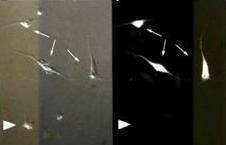
cone-enriched cultures |
Most often, cone photoreceptors get touched. Cone photoreceptors are
responsible not only colour vision but most importantly high contrast
vision, visual acuity and all the vision in normal light
environment. During the natural history of the disease, the central
vision is reduced to blindness. The first symptoms appear usually
during childhood (between 10 and 20 year).The evolution of the disease
occurs in general during 20 to 30 years. At 60, the vision is inferior
to 1/10 (blindness). Cone are also affected in a polygenic ageing
disease Aged-related Macular Degeneration (AMD).
Among the corrective therapy approaches now envisioned, gene therapy
has only a restrict potential since it is selective, while the
neuroprotective approach are broadly applicable but non-selective. The
fact that more than 100 different RP genes have been identified, is a challenge for the
development of corrective gene therapy approaches.
The scientific approach at Inserm Unit592 - University Pierre and
Marie Curie in Paris derives from the analysis of events leading to
secondary cone degeneration, in order to develop novel strategies
aimed at limiting their loss. The observation that cone degeneration
follows that of rods led us to formulate the hypothesis of a trophic
signalling from rods to cones. The transplantation of sheets of rod
photoreceptors into the eye of a mouse model of retinitis pigmentosa
was done when all rods have degenerated but before at the onset of of
cone loss. The grafting was shown to slow down cone degeneration by
half.
The Inserm Unit592 - University Pierre and Marie
Curie has undertaken a systematic strategy to identify and
characterize endogenous cone viability factors using an expression
cloning approach. This research has already led to the identification
of a novel protein, Rod-derived Cone Viability Factor (RdCVF) secreted
and expressed specifically by rods (608791).
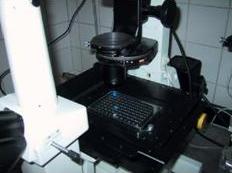
Cell counting |
The sequencing of a normalized mouse retinal library by the Génoscope at Evry should optimize the screening by expression cloning using a bioinformatics analyses.
The identification of RdCVF is a key step toward the
therapeutic goal as well as it opens many new perspectives. The
potential use of RdCVF for therapy is large since the expression of
the protein is not affected by the primary genetic defect. RdCVF
delivery might even be performed at late stage in the disease since
95% cone loss compatible with a correct orientation and discrimination
performance and 50% cone loss compatible with acuity of 20/20 (normal
acuity).
The clinical extension of that research will be performed within the
future Institut de la Vision (Paris XV-XX).
|





 home |
overview |
resources |
sequencing |
news |
press releases |
site |
Legal information

