What are brown algae ?
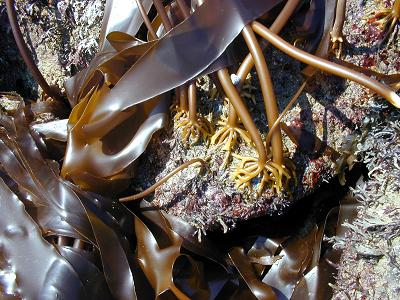
The brown alga Laminaria digitata
growing on the Brittany coast
Photo : Stéphane Labarre, UMR7139 |
From an evolutionary point of view, the algae are a heterogeneous group and include
organisms from several distinct lineages. The brown algae, or class Phaeophyceae, are part of a group
of organisms called the heterokonts (which also includes diatoms and oomycetes) and are only very
distantly related to green and red algae (Baldauf, 2003). The vast majority of brown algae occur in
marine environments. All members of the group are multicellular, with morphologies ranging from uniseriate
branched filaments to complex parenchymatous thalli with multiple cell types, including conducting tissue.
The thallus of the kelp Macrocystis pyrifera, for example, can reach up to 70 metres in length. The colour
of brown algae is due to the presence of fucoxanthin, a xanthophyll pigment and the principal carbohydrate
reserve is laminaran (rather than starch). In addition to cellulose, the cell walls of brown algae contain
a variety of other polysaccharides including alginates and fucans.
Why are brown algae interesting?
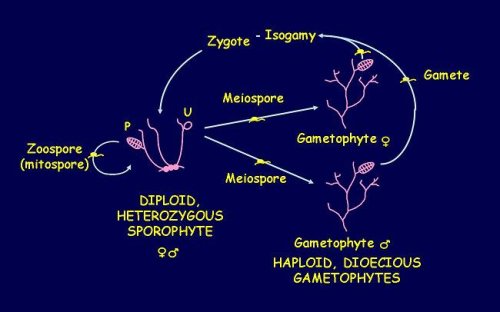
The haploid-diploid life cycle of
Ectocarpus siliculosus.
The sporophyte and gametophyte are slightly heteromorphic, the gametophyte
is dioecious and sex determination is genotypic. U: unilocular sporangium, P: plurilocular sporangium |
Complex multicellularity - Complex multicellularity has arisen rarely during evolution and the brown
algae are one of only five eukaryotic lineages that have evolved this characteristic (the four others being
animals, green plants/algae, fungi and red algae). Each of these lineages is thought to have independently
evolved the developmental control mechanisms needed for the construction of a complex multicellular organism.
In animals and higher plants, the molecular basis of many developmental processes is well understood but
surprisingly, considering the fundamental importance of multicellular development, very little is known
about this process in the other three lineages with almost nothing being known about the molecular basis
of development in the brown and red algae.
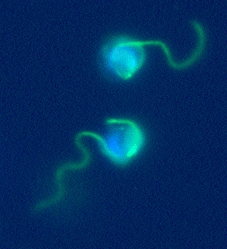
Ectocarpus gametes with their flagella and
DNA stained green and blue, respectively.
The long undulating flagellum is the anterior one.
[for a scale: the diameter of the lower gamete is 7 µm]
Photo : Delphine Scornet, UMR7139 |
Life cycles and mating types - In addition to being of general interest as complex multicellular organisms,
brown algae exhibit several novel features particularly in relation to their life cycles and mating behaviour.
Life cycles range from diplontic in Fucus to the nearly isomorphic, haploid-diploid life cycle of Ectocarpus whereas
their sexual systems include both dioecious and hermaphrodite states and isogamy, anisogamy or oogamy. Haploid-diploid
life cycles like that of Ectocarpus are of particular interest because they imply the existence of genetic control
mechanisms that regulate the deployment of the two alternative, independent developmental programmes, influencing
development at the level of the whole organism.
Early embryogenesis - Fertilisation is external in brown algae, involving fusion of naked gametes that have been
released into the surrounding seawater. This feature has been exploited widely to study many aspects of early development
including gamete fusion at fertilisation, establishment of polarity, the involvement of cell walls in early developmental
signalling, initiation of the first cell cycle, coupling between the cell cycle and developmental processes and other aspects
of development during early embryogenesis (Berger et al., 1994; Bouget et al., 1998; Corellou et al.
, 2000, 2001; Brownlee et al., 2001). Several cellular phenomena are highly novel in this group; cytokinesis,
for example, has been shown to exhibit features typical of both animals and terrestrial plants (Nagasato and Motomura, 2002).
Endosymbiosis and the origin of chloroplasts - The chloroplasts of green plants and red algae are thought to be
derived from an ancient cyanobacterium that was engulfed by a eukaryotic host cell. The chloroplasts of heterokonts,
such as the brown algae, have a more complicated origin. They have been acquired via a secondary endosymbiotic event
in which a chloroplast-containing organism similar to a red alga was itself engulfed by another eukaryote (Yoon et al.,
2002). This convoluted history, which has left brown algal chloroplasts with several unusual features such as the four concentric
membranes that surround the organelle, involved several phases of transfer of genes to the nucleus. The Ectocarpus genome
sequence will allow these events to be traced at the gene level.
Responses to biotic and abiotic stress - The rocky shore habitats of most brown algae are stressful environments in which these organisms are subjected to both biotic aggression from grazers and pathogens and various abiotic stresses including large variations in temperature, immersion, light irradiation and mechanical forces. In consequence, the brown algae represent novel model systems for several aspects of responses to biotic and abiotic stresses including innate immunity (Potin et al., 2002), viral infection (Müller et al., 1998; Delaroque et al., 2001), novel pathosystems (Küpper et al., 2001, 2002; Maier et al., 2000) and osmotic stress (Coelho et al., 2002).
Industrial uses and production of bioactive molecules - In addition to the above fundamental points of interest, it is important to note that seaweeds also represent a marine resource with a wide range of uses in the food, cosmetic, and fertiliser industries and an estimated annual global value of about 4.5x10⁹ euros (McHugh, 2003). They are also attracting increasing attention as a novel source of bioactive molecules, one example being IODUS 40, a formulation that is derived from a storage glucan of Laminaria digitata and which stimulates the natural defence responses of crop plants.
Ectocarpus siliculosus: a genetic and genomic model
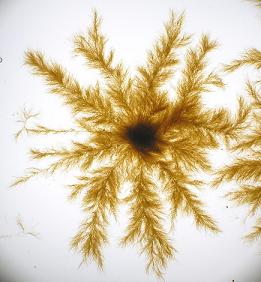
An Ectocarpus sporophyte grown in culture
Photo : Delphine Scornet, UMR7139 |
Brown algae from the orders Laminariales and Fucales have been studied extensively in the past but such models are poorly adapted for genomic and genetic approaches because of their large genomes (ca. 700 and 1100 Mbp, respectively) and because it is very difficult to complete their life cycles in the laboratory. To address this problem, a survey of brown algal species was carried out in Roscoff (Peters et al., 2004a) and this led to the choice of the filamentous alga, Ectocarpus siliculosus, previously studied over many years by Dieter Müller at the University of Konstanz, as a model species for this group. The choice of Ectocarpus was based on several characteristics including its small size, the fact that the entire life cycle can be completed in Petri dishes in the laboratory (Müller et a.l, 1998), its high fertility and rapid growth (the life cycle can be completed in 2-3 months), the ease with which genetic crosses can be carried out (Peters et al., 2004b) and the relatively small size of the genome. Moreover, the Ectocarpales are closely related to the most economically important brown algal group, the Laminariales (Draisma et al., 2003). Several classical and molecular genetic tools are being developed for Ectocarpus including transformation and RNA interference protocols. Mutant lines can be created by UV irradiation and screens for mutants are greatly facilitated by existence of a haploid phase in the life cycle.
|





 UMR 7139 CNRS-Goëmar-UPMC
 home |
overview |
resources |
sequencing |
news |
press releases |
site |
Legal information

