| -> Access to sequencing project |
|
Collaboration
 Equipe de Génomique Intégrée des
Interactions Microbiennes
Laboratoire de Biologie des Protistes
UMR CNRS 6023
63177 AUBIERE- Genoscope - Centre National de
Séquençage
UMR CNRS 8030
91057 EVRY
|
|
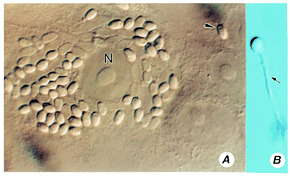
(A) A host cell infected with Brachiola algerae. Note the arrangement of spores around the host (E6 cell) nucleus (N). A single spore is probably in the process of infecting an adjacent cell (arrowhead). Magnification, x1,200
(B)A spore with an everted polar tubule. Magnification, x1,200
(Visvesvara, Clinical Microbiology Reviews, July 2002, p. 401-413, Vol. 15, No. 3) |
The microsporidia,
which form a phylum including about 1200 known species, are obligate
intracellular eukaryotic parasites capable of parasitizing practically
all members of the animal kingdom, thus demonstrating formidable
capacities for adaptation. These parasites create major problems in
human and veterinary health.
The Encephalitozoon cuniculi
sequencing project has been completed, and has provided information on the
novel structure of microsporidian chromosomes.
In order to obtain more in-depth knowledge of these pathogens (metabolic capacities,
host-parasite relationships, genome structure), the sequencing of the
genome of the microsporidian, Brachiola algerae (synonym of Nosema
algerae) has been undertaken.
Brachiola algerae was discovered in the larvae of Anopheles mosquitoes
(Vavra and Undeen, 1970). The spores are ovoid and are about 4.4 x 2.8
um. As in all microsporidia, Brachiola algeria possesses a polar tube
rolled up in the spore which permits invasion of a new host. This
structure for invasion, which is unique in the living world,
facilitates the passage of the infectious sporoplasm (nucleus,
cytoplasm) from the parasite to the host cell.
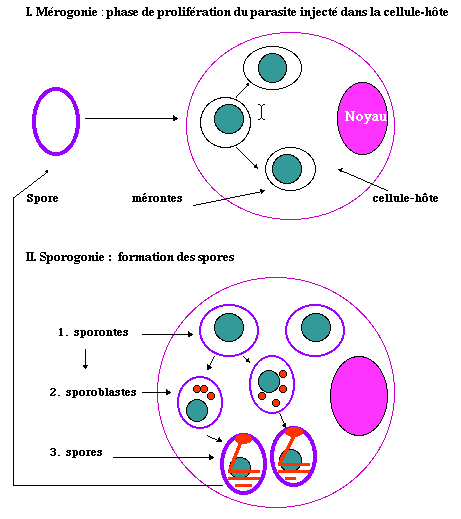
Both phases take place in the same host cell
(Desportes, Évolution des Parasites et des relations hôtes-parasites, 2-3-4 mai 2001) |
The "diplokaryotic nucleus" is present during all the developmental
stages (merogonie: cell multiplication and division and sporogony:
differentiation of the spore). Vegetative multiplication and
differentiation occur directly in contact with the cytoplasm of the
host cell. It is interesting to note developmental differences with
the first microsporidium sequenced, Encephalitozoon
cuniculi. E. cuniculi has a monokaryotic nucleus, the development
cycle takes place in the inside of a parasitophoric vacule, and the
spores are smaller (2.5 x 1.5 um).
Since microsporidia are intracellular parasites, the developmental temperature depends directly on the body temperature of the host. Therefore, microsporidial parasites of insects develop at a temperature below or equal to 35 degrees C, whereas microsporidial parasites of mammals develop at a temperature above or equal to 37 degrees C.
Studies on Brachiola algerae have shown that development is
also possible in vertebrate cell culture at temperatures from 24 to 38
degrees C (see Lowman et al., 2000, for a review). Furthermore,
B. algerae is capable of infesting the tail and foot pads of athymic
mice (Trammer et al., 1997), and more recently, it has been identified
in the cornea of an immunocompetent patient (Visvesvara et al.,
1999). This human isolate has been used to infect immunodeficient mice
(Koudela et al., 2001). After application to the eye, the development
of the parasite causes a severe infection of the liver of the mouse,
without causing a lesion in the eye. The physico-chemical conditions
in the eye permit a metabolic adaptation of this microsporidium which
mainly infects poikilothermic organisms (insects), making the
infestation of homeothermic organisms possible also (mammals). This
species therefore has great adaptation potential concerning the host
range (insects, mammals), the type of cell infested (muscle, kidney,
cornea, intestine, and this is probably far from an exhaustive list)
and is capable of multiplying and differentiating over a large
temperature range (24 to 38 degrees C).
Other studies have demonstrated that Brachiola algerae
infection of a mosquito parasitized by Plasmodium falciparum
leads to a reduction in development of the causative agent of malaria,
suggesting a possible biological control (Margos et al., 1992).
It seems reasonable therefore to concentrate our efforts on Brachiola algerae (adaptation capacities), a mosquito parasite which is also capable of infesting mammals and notably humans, in the context of the sequencing of the genomes of Plasmodium falciparum (causative agent of malaria), the Anopheles mosquito (vector of P. falciparum) and humans.
|





 home |
overview |
resources |
sequencing |
news |
press releases |
site |
Legal information

