The chaetognaths are small marine invertebrates (from 2 to 120 millimeters in length), mainly planktonic. They are called "arrow worms" because of their transparent body which is long and lean, with lateral and caudal fins. These are predatory swimmers; they have chitinous spines around their mouth -their Greek name means "bristle-jaw"- which can be retracted under a hood. They eat small invertebrates such as copepods, and even alevins. The anatomy of the chaetognaths is very simple: two transverse septa close off the main cavity and delimit a head, a trunk (including the female genital coelom) and a tail (with the male genital coelom). The organisms are hermaphroditic and fertilization is internal. Development is direct. Chaetognaths are found in coastal waters of the Metiterranean sea as well as the Atlantic ocean and the English Channel.
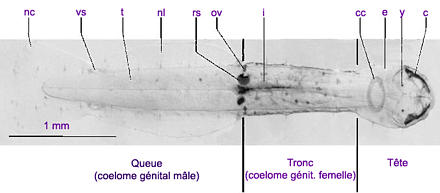
Spadella cephaloptera : c, jaws ; cc, ciliary crown ; e, epiderm ; i,
gut ; nc, tail fin ; nl, lateral fin ; ov, oviduct ; rs, seminal
receptacl ; t, testes ; vs, seminal vesicle ; y, eyes. (credit X. Caubit) |
The Chaetognaths constitute a small phylum of about one hundred species. In spite of its modest size, this group has aroused the curiosity of scientists for over a century, because it has not been easy to classify it on the tree of bilaterian animals (animals with bilateral symmetry, i.e. most animals but sponges and jellyfish). In 1844, Darwin described these animals as "remarkable for obscurity of their affinities". Since then, they have been placed in a large number of different positions. Before the advent of molecular phylogenies, zoologists tended to place them with the Echinoderms (starfish), Hemichordates and Chordates (ascidians, Vertebrates) within the Deuterostome group, i.e. the animals in which the mouth forms secondarily, and is never derived from the first orifice of the embryo. Indeed, the chaetognaths do present this characteristic, as well as another Deuterostome trait: the enterocoelous development of the coelom (i.e., the coelom forms from outpocketings of the embryonic gut). Their photoreceptor cells also bear resemblance with those of the Chordates. However, other characteristics are shared with the Protostomes, the other large group of animals with bilateral symmetry (Mollusks, Annelids, Arthropods, Nematodes, etc.). These include the ventral position of the nervous chain and the presence of chitin. Finally, molecular phylogeny studies, which are sometimes divergent, agree on at least one point: they exclude the chaetognaths from the deuterostomes sensu stricto. However the reliability of these studies is limited by the artefact of long-branch attraction: the rapid evolution of gene sequences studied to date in the chaetognaths may have led to placement of this lineage toward a basal position in the tree.
In any case, the preliminary results of the
molecular analysis are in agreement with those of the morphologic
analysis: the mosaic of characteristics exhibited by the chaetognaths
is an indication of the ancestral character of this lineage. The
paleontological evidence also supports this, because fossils dating
back to more than 500 million years have been assigned to this group
(Chen & Huang). Since inclusion in the
Deuterostome group has been excluded, several hypotheses remain
possible, including :
- The chaetognath lineage may have separated very early, before
the Protostome-Deuterostome divergence. These animals would then
be the group of choice for reconstituting the common ancestor of
all the bilaterians (which, of course, does not imply that the
chaetognaths would necessarily resemble this ancestor).
- The chaetognath lineage may have separated after the
divergence of the Protostome branch. It would therefore occupy a
basal position in the Protostome tree, outside of the two large
groups of Lophotrochozoa (Mollusks, Annelids, Brachiopods, etc.)
and the Ecdysozoa (Arthropods, Nematodes, etc.); alternatively
they could be placed within one of these groups.
The determination of the phylogenetic position of
the chaetognaths is very important, because it will then be possible
to polarize the major traits used to define the Deuterostomes. In the
two scenarios presented above, deuterostomy and enterocoelous
development of the coelom would thus be ancestral (plesiomorphic)
traits of the bilaterians, inherited in common by the chaetognaths and
the Deuterostomes, and lost at a later time in the Protostome
branch. However, the less probable hypothesis of convergent
acquisition of deuterostomy in both chaetognaths and Deuterostomes
cannot be excluded.
New genomic data, combined with the first sequences
of genes used for phylogeny (18S RNA, intermediate filaments), have
advanced the study of the position of the chaetognaths in the
Bilaterian tree. The mitochondrial genomes of two species of
chaetognaths - Spadella cephaloptera (Papillon et al., 2004) and Paraspadella
gotoi (Helfenbein et al.) - have recently
been sequenced. These have turned out to be the smallest mitochondrial
genomes known in animals, with only 13 and 14 genes
respectively. After examining these sequences, the two groups have
concluded that the chaetognaths are closely related to the
Protostomes, and thus rejected the scenario of branching before the
Protostome-Deuterostome divergence.
The phylogenetic position of the chaetognaths must
be clarified by the study of new sequences. The sequencing
project undertaken by Genoscope on the initiative of a consortium of three laboratories consists in
sequencing a collection of expressed sequence tags (ESTs). This should
produce a large number of molecular markers which should provide
phylogenetic information. The congruence of the trees obtained with
these different markers will be verified. The ESTs will have other
uses as well: the cDNAs were prepared from different embryonic stages
of Spadella cephaloptera, and will certainly yield new
developmental genes (a Hox gene with an unusual type of
structure has already been studied (Papillon et al.,
2003)). Spadella cephaloptera is well-adapted to the
methods of in situ analysis of gene expression, because the
eggs and the embryos are totally transparent. This species lives in
Posidonia oceanica seagrass meadows, in shallow water not far
from the shore, and is therefore easy to collect. Furthermore, the
reproductive cycle of Spadella cephaloptera is fully mastered
by one of the three groups, and the different pre- and post-hatching
developmental stages of this animal have been well
characterized. Analyzing the expression of genes of interest at each
of these stages will help explain the origin of the molecular
mechanisms which control the development of metazoans and their
evolution, in relation to the genesis of the different body plans in
the bilaterians (the "evo-devo" paradigm).
At the national level, the participant teams have
produced a library of BAC clones within the framework of a "scientific
interest group" (GIS) named "Genomique marine". This library will be
useful in the isolation of the cluster of Hox genes of
Spadella cephaloptera, which will provide new information on
the evolution of body plans. The three groups are also members of a
marine genomic network in the framework of the sixth PCRD, where they
are promoting the chaetognath model.
- J.Y. Chen & D.Y. Huang, Science (2002) 298, 187
- D. Papillon et al., Dev. Genes Evol. (2003) 213, 142-148
- D. Papillon et al., Mol. Biol. Evol. (2004) 21, 1-8
- K.G. Helfenbein et al., Proc. Natl. Acad. Sci. USA (2004) 101, 10639-10643
|





 home |
overview |
resources |
sequencing |
news |
press releases |
site |
Legal information

