The marine
cyanobacteria of the genus Synechococcus carry out a large
portion of carbon fixation in the oceans, and their genomes are among
the most abundant on the planet. Together with their relatives from
the genus Prochlorococcus,
these photosynthetic prokaryotic cells are the predominant members of
the marine phytoplankton, which is responsible for about half of the
world’s photosynthesis. Therefore, the study of these organisms is of
great biological and ecological interest.
Although the genus Synechococcus is less abundant than
Prochlorococcus on a global scale, it is more ubiquitous and
more diverse. In tropical and equatorial zones, both genera co-inhabit
the central zones of the oceans which are characterized by a lack of
mineral elements (oligotrophy). Although it is Prochlorococcus
which predominates in these regions, Synechococcus gains the
upper hand as soon as the waters become richer, i.e. in upwelling
zones where deep water rises to the surface, or in coastal areas. The
great ubiquity of the genus Synechococcus can be explained by
the fact that there are strains which are genetically and
physiologically adapted to different environmental conditions; some
prefer central oceanic zones and others like coastal areas which are
rich in nutrients. (It is important to note that the marine
Synechococci are phylogenetically very distant from the
Synechocococci found in fresh water or in hydrothermal vents;
they are closer to the genus Prochlorococcus with which they
form a monophyletic group).
In contrast to the cells of unicellular algae such as diatoms, the
cells of Prochlorococcus and Synechococcus are very
small - of the order of one micron - which explains the fact that
despite their abundance, they were unnoticed for a long time, and the
central ocean zones were considered to be a biological
desert. Measurements of chlorophyll, however, had suggested that part
of the plankton was not being detected. The marine representatives of
the genus Synechococcus, discovered in 1979, were the first
described elements of this "picoplankton" which, as we now know, plays
an important role in the function of the global ocean: although the
oligotrophic regions of the oceans possess a small biomass per unit of
volume compared to the rich coastal areas, on the other hand, they
extend over a very large surface.
The marine strains of Synechococcus possess several remarkable characteristics:
- First of all, the capacity to assimilate mineral elements present
at concentrations inferior to one micromole per liter in the
oligotrophic zones of the ocean. Furthermore these marine strains are
adapted in a radical way to living at very low concentrations of iron,
which is especially limiting in deep-sea environments: they use other
metals such as nickel with certain key metabolic enzymes.
- Next, their photosynthetic antenna (phycobilisomes) are adapted to
the spectral quality of light in the ocean, as they can synthesize
unique photosynthetic pigments.
- Finally, some strains which have been isolated from the open sea
are capable of motility using an original system of locomotion which
is totally different from flagella and other locomotor organelles
which are normally found in bacteria. These motile strains do not
respond to gradients of light, but to very weak gradients of nitrogen
compounds.
The first genome of Synechococcus to be sequenced was in fact
one of these motile marine strains: WH8102, a strain that dwell in the
most nutrient-poor zones of the oceans. Its 2.4 Mb genome was
sequenced by the Joint Genome Institute (Walnut Creek, California) and
the analysis
of this sequence has been published in Nature in August
2003, at the same time as those of the sequences of three strains of
Prochlorococcus. Two members of the "Oceanic
Phytoplankton" group from the Roscoff Biological Station, Frederic
Partensky and Alexis Dufresne, participated in the annotation of the
WH8102 genome, by describing the photosynthetic genes.
One of the reasons for sequencing WH8102 is that this strain can be
manipulated genetically. All the conditions for making this a model
organism are thus now fulfilled, and several groups from the
Department of Energy (DOE, GTL
program) in the United States are working to model carbon fixation
in this cyanobacterium. The choice by DOE can be explained by the
present interest in carbon sequestration in the framework of the fight
against climate warming. There has been some initiatives to increase
locally the primary productivity of the oceans (to which
Synechococcus is a major contributor, as we have seen) via an
iron "seeding" operation. Beyond these controversial ecologic
applications, studies on Synechococcus have a more fundamental
goal. They will produce a large quantity of various types of data
(genomic, transcriptomic, proteomic, etc.), for which a Synechococcus
encyclopedia will soon provide access.
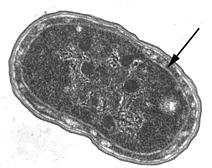 | 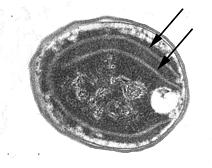 | 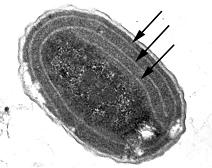 |
| Electron micrograph of Synechococcus sp. WH7803 grown under three light intensities: 1330 µE m-2 s-1 (left), 160 µE m–2 s-1 (middle), and 30 µE m-2 s-1 (right). The concentric lines at the periphery of the cells are thylakoidal membranes, which are centers of photosynthesis, and for which the number varies inversely with the intensity of light provided during growth (Kana and Glibert, 1987). |
However, the WH8102 strain has not been extensively characterized in
physiologic terms until recently. Furthermore, this strain does not
reflect the large ecophysiologic and genetic diversity of the
genus. It is therefore important to sequence Synechococcus
strains which are representative of other clades and other
environments. A consortium of laboratories,
mainly European, coordinated by Frederic Partensky at the Roscoff
Biological Station, has selected two strains for this purpose: WH7803,
which is a strain representative of mesotrophic waters (rich in
nutrient salts) and is the best characterized physiologically as well
as being easy to manipulate genetically; and RCC307, an oceanic strain
which presents great phylogenetic interest because the trees obtains
using the 16S RNA gene seem to indicate that it is rooted at the base
of the radiation of marine cyanobacteria.
The analysis of genomic sequences should lead to an understanding of the ecophysiologic and pigmentary characteristics of the two strains, as well as their mechanisms of adaptation to their specific ecological niches. Moreover, the comparison of these genomes with that of WH8102, as well as those of the strains of Prochlorococcus and other cyanobacteria which have been sequenced, will provide information on the evolution of genomes within this very important group of photosynthetic prokaryotes. Also, the WH7803 strain, which can be easily manipulated genetically, can be used for post genomic studies with the goal of identifying, for example, genes which are specific for ecological niches. Several mutants of this strain have already been obtained by two members of the consortium. Sequence data from these two strains can therefore be used in a whole series of research projects in marine genomics, a domain which has been identified as a priority initiative by the French ministry of research (creation of the GIS "Institut de la Génomique Marine", 2003-2006) as well as the European research authorities (the "Marine Genomics" networks of excellence that have been recently accepted in the framework of the sixth PCRD).
|





 An
 home |
overview |
resources |
sequencing |
news |
press releases |
site |
Legal information

