|
[an error occurred while processing this directive]
Frankia alni ACN14a
A symbiotic nitrogen-fixing actinobacterium |
|
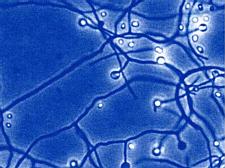
Culture of Frankia alni showing vegetative branched septate hyphae as well as diazovesicles, thick-walled cells specialized in nitrogen-fixation. (photo Y. Hammad) |
Bacteria of the genus Frankia belong to the class
Actinobacteria. These bacteria were originally linked to fungi,
because of the mycelium-like filaments many of them form. They have
Gram-positive cell walls and their genomes display a high percentage
of bases G and C (high G+C%). Actinobacteria notably include bacteria
of the genus Mycobacterium, the causative agents of
tuberculosis and leprosy, and bacteria of the genus
Streptomyces, which produce many antibiotics.
Twelve species of Frankia are recognized today. These are
nitrogen-fixing bacteria which live in symbiosis with a large spectrum
of dicot plants (24 genera belonging to 8 families). These plants,
with their symbiotic bacteria, are collectively responsible for 15% of
the biologically fixed nitrogen in the world. Actinobacteria are not the
only group that includes nitrogen-fixing bacteria : some are also
found among the alpha-proteobacteria - Azospirillum which
promotes the growth of graminaceae or Rhizobium, which fixes
nitrogen in nodules formed on the roots of legumes - and among
cyanobacteria - one species of which lives in symbiosis with
the leaves of a water fern Azolla.

Longitudinal section of a dichotomous alder nodule stained to highlight the enlarged cortical cells packed with Frankia diazovesicles. The basal diameter is about 2mm. (photo P. Normand) |
The Frankia alni ACN14a strain was isolated from a green alder (Alnus crispa) growing in Tadoussac, Canada. This bacterium is able to establish a nitrogen-fixing symbiosis with alder (Alnus spp. ) and myrtle (Myrica spp. ), two pioneer plant genera of temperate regions, found on forest clearings, mine wastes, sand dunes and glacial moraines where nitrogen is the limiting factor. Frankia alni causes root hair deformation: it penetrates the cortical cells and induces the formation of nodules which resemble those induced by Rhizobium in legumes. These nodules are then colonized by vegetative hyphae (mycelium filaments) which differentiate into diazo-vesicles. It is in these specialized, spherical, thick-walled cells that reductive nitrogen fixation takes place, protected from molecular oxygen by numerous layers of tightly stacked hopanoid lipids. No genetic system exists so far for unraveling the workings of the symbiosis between Frankia and its hosts. However, sequencing the genome of the ACN14a strain will help us understand how this interaction takes place, the nature of secondary metabolites produced, and how evolution has proceeded. The Frankia alni genome sequence will be analyzed through comparison with other sequenced actinobacteria: Streptomyces, Mycobacterium, Corynebacterium, Tropheryma and Bifidobacterium.
The Frankia sequencing project, which takes the form of a
collaborative project between Genoscope, the CNRS and the University
of Lyon (Center for
Microbial Ecology, UMR CNRS 5557), with help from numerous other
teams, began in October 2003.
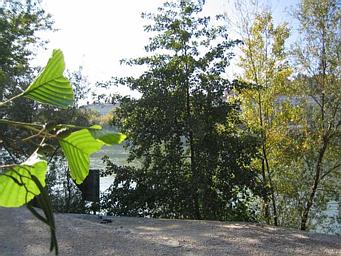
Black alder (Alnus glutinosa L.) growing on the Rhone river bank in Lyon. On the left are male inflorescences (bottom) and infructescences (top). Alder has physiological adaptations that result in retention of a green foliage in the fall while neighboring trees turn yellow because they remobilise nitrogen. The alder litter is thus very rich in nitrogen, a fact that favors ecological successions. (photo P. Normand) |
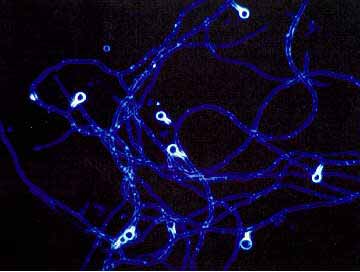
Culture of Frankia sp. (strain CcI3) under nitrogen depletion and hyperbaric oxygen pressure (70%) conditions. Nitrogen depletion induces nitrogen fixation by the nitrogenase enzyme, whereas oxygen, a poison for the enzyme, is kept out by the synthesis of diazovesicles, spherical thick-walled cells specialized in nitrogen-fixing. Their wall is made of numerous layers of compact hopanoid lipids highlighted here by dark-field microscopy. The number of layers, and thus the thickness, are a function of the pO2. (photo W. Silvester and R. Parsons) |
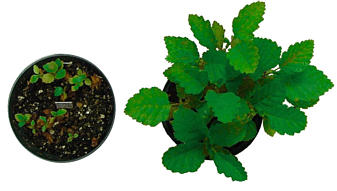
Nodulation test of Frankia
alni strain ACN14a on Alnus glutinosa seedlings growing on a
nitrogen-free artificial substrate. The seedlings on the left are the
non-inoculated controls whose growth is markedly reduced (photo B. Mullin).
|
|
[an error occurred while processing this directive]
|
|
|







 home |
overview |
resources |
sequencing |
news |
press releases |
site |
Legal information

