The marine cyanobacteria from the Prochlorococcus genus are the
smallest photosynthetic organisms known; they are also the most
abundant photosynthetic organisms in the oceans, and therefore on the
planet. With a size of less than one micrometer (diameter between 0.5
and .07 micrometer), these prokaryotic cells were not noticed until
the end of the 1980s, although the existence of photosynthetic
organisms of the order of one micron in size (picophytoplankton) has
been known since 1979. In fact, the cells of Prochlorococcus
were indistinguishable from heterotrophic bacteria with traditional
microscopic techniques, and only flow cytometry revealed their
presence: in 1988, S.W. Chisholm and her group from the Massachusetts
Institute of Technology (MIT) announced that they had discovered a new
class of prokaryotic picoplanktonic organisms using a flow cytometer
on board a ship. These cells were different from typical cyanobacteria
of the genus Synechococcus in their weak red fluorescence
signal and almost complete absence of orange fluorescence, which
indicated a very unusual composition of photosynthetic pigments for a
cyanobacterium. Furthermore, these organisms seemed to be very
abundant - more than 100 000 cells/milliliter in open seas, which are
very poor in minerals (oligotrophy). We know today that the
cyanobacteria of the genus Prochlorococcus are the dominant
organisms in terms of numbers in the central zones of all the oceans
between 40 degrees north latitude and 40 degrees south. In these
oligotrophic waters, they represent 40 to 50% of the phytoplankton
biomass. Moreover, they are present down to 200 meters under the
surface, a depth at which light energy is a thousand times weaker than
at the surface.
The reasons for studying the bacteria from the Prochlorococcus
genus are numerous. First of all, these are organisms of great
ecological importance; along with other marine cyanobacteria from the
Synechococcus
genus, these cells are some of the principal primary producers of the
phytoplankton, which is responsible of half of the photosynthesis on
the planet. These bacteria are therefore prominent actors in global
oceanic function, in the carbon cycle, and consequently in the
evolution of climate.
Bacteria of the Prochlorococcus genus are also quite remarkable in their adaptations:
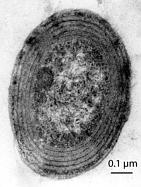
- a tiny size which facilitates the acquisition of mineral salts - which are present in very low concentrations — due to the increase in the surface/volume ratio; furthermore, the reduction in cell diameter increases the coefficient of absorption of the photosynthetic pigments by reducing the package effect: the presence of several layers of photosynthetic membranes (or thylakoids) has the effect of reducing the contribution of pigments situated in the interior parts of the cell relative to the more peripheral pigments, and this effect diminishes with the size of the cell.
- a genome with a very small size in some strains, a characteristic
which is certainly due to the small size of the cells and the low
concentrations of nitrogen and phosphorus which makes nucleotides
costly. The great stability of the environment of these strains makes
the consequences of gene loss - i.e. loss of potential for adaptation
- less detrimental. With a size of about 1.7 Mb, the genomes of these
strains are the smallest known among the cyanobacteria, and more
generally among oxyphototrophic organisms. The inventory of the genes
retained in such "minimal" genomes is of great interest.
- an unusual pigment composition, with the presence of divinyl
derivatives of chlorophyll a and chlorophyll b, unique to the genus
Prochlorococcus. These pigments, which are associated with
proteins in the thylakoid membranes, constitute the major
photosynthetic antenna of Prochlorococcus. In the "typical"
cyanobacteria, on the contrary, and notably in Synechococcus,
chlorophyll a plays only a secondary role and the solar energy is
mainly collected by complexes called phycobilisomes, which contain
highly colored pigments, the phycobilins, and other proteins. The
phycobilisomes seem to be absent in Prochlorococcus, or present
as only vestigial structures in some strains. This replacement of
phycobilisomes by a chlorophyll a/b antenna embedded in the thylakoid
membranes is also found in two other organisms, Prochloron and
Prochlorothrix, which are sometimes grouped with
Prochlorococcus under the name "prochlorophytes". The nature of
the antenna is similar in the three prochlorophytes and its
organization in the thylakoids is reminiscent to that of green algae
and higher plants. It has been shown, however, that the
prochlorophytes form three well-separated lineages in the radiation of
the cyanobacteria, and that none of the three genera is on the lineage
which leads to the chloroplasts of plant cells. This therefore
represents a remarkable example of convergent evolution. Furthermore,
Prochlorococcus also differs from other prochlorophytes in the
presence of alpha-carotene instead of beta-carotene, in addition to
the presence of the divinyl derivatives of chlorophylls.
An understanding of the role of Prochlorococcus cyanobacteria
in the global oceanic ecosystem will require a detailed study of their
physiological characteristics. These characteristics seem to be
remarkably diverse, with the presence of at least two ecotypes which
are genetically and physiologically quite different; between these
ecotypes, and even within them, there is a great variation in traits
such as pigment ratios, optimal light intensity for growth, efficacy
of absorption of the antenna, capacity to use nitrogen, specificity
with regard to cyanophages (phages which infect cyanobacteria),
etc.
These differences may appear surprising at first for a
photoautotrophic organism which requires only light, carbon dioxide
and mineral salts for growth and which lives in an environment made
uniform by the movement of the water. The water column in the central
zones of the oceans at tropical and sub-tropical latitudes is in fact
stratified by density and offers several ecological niches: the
surface waters receive a large amount of light energy and the
concentration in mineral salts is very low; on the other hand, the
region between depths of 100 and 200 meters receives very little light
with wavelengths shifted toward the blues, but is richer in nutrient
salts. The strains of Prochlorococcus which grow in the surface
waters form the high-light-adapted ecotype; their antennae contain
mainly the divinyl derivative of chlorophyll a. The strains which grow
preferentially at depths between 80 and 200 meters form the
low-light-adapted ecotype and contain a lot of divinyl-chlorophyll b,
which absorbs optimally in the blue area of the spectrum. The genomes
of these strains possess several copies of the gene which codes for
the antenna protein; this is likely an adaptation to weak
luminosity.
In order to elucidate the genetic basis of these adaptations more
completely, scientists have undertaken the sequencing of strains of
Prochlorococcus from different ecological niches. The Joint
Genome Institute (Walnut Creek, California) has sequenced the genomes
of two strains which are representative of high-light-adapted(the MED4
strain) and low-light-adapted (the MIT9313 strain) ecotypes. However,
the genetic diversity of the low-light-adapted strains is much greater
than that of high-light-adapted strains, and the genome sequence of
the strain MIT9313 is not sufficient to illustrate evolutionary
tendencies in these "deep water" strains. The sequencing of another
low-light-adapted strain was therefore undertaken in parallel at
Genoscope on the initiative of the "oceanic
phytoplankton" team at the Roscoff Biological Station. This
strain, named Prochlorococcus marinus SS120, is the type strain
of the genus Prochlorococcus, and the best characterized from
an ecophysiological point of view. From the phylogenetic point of
view, the SS120 strain seems rather distant from the other deep water
strain sequenced, MIT9313, which is rooted at the base of the
radiation of Prochlorococcus.
The genomic sequences of Prochlorococcus SS120, MED4 and
MIT9313 were described in two papers published
in August 2003, at the same time as the sequence of a strain of marine
Synechococcus, and their comparison have been instructive. The
first lesson from these sequences is the confirmation of the
heterogeneity of the deep water strains: the genome of SS120, which is
1.75 Mb and contains 1884 genes, is almost as small as the genome of
the high-light-adapted strain MED4 (1.66 Mb, 1716 genes) and presents
as a quasi-minimal genome; on the contrary, the genome of the second
deep-water strain, MIT9313, is much larger (2.4 Mb, 2275
genes). Moreover, the annotation indicates that this latter strain is
capable of exploiting a larger range of nutrients. For example,
MIT9313 can use ammonium ions, nitrite, nitrate, cyanate, urea, amino
acids and peptides as a source of nitrogen, whereas SS120 can only use
ammonia and amino acids. SS120 seems to be adapted to a very stable
environment at the limit of the zone of penetration of light, whereas
MIT9313 seems to be adapted to less deep waters, corresponding to a
transition zone in which the available resources are more diverse.
A comparison of the genomic sequence of Prochlorococcus marinus
SS120 with that of the three fresh-water cyanobacteria which have
already been sequenced reveals the nature of the absent or
under-represented genes in the "minimal" genome of SS120: certain
photosynthetic genes, and genes implicated in DNA repair, importation
of solutes, intermediary metabolism and in numerous other
functions. In particular, the genes involved in signal transduction
and the response to environmental stress have suffered a drastic
reduction in SS120, probably because of the great stability of the
environment of this strain. Another factor in the compactness of the
genome of SS120: it contains very few paralogous genes. One of the
rare examples of gene amplification involves the 8 pcb genes
encoding the antenna proteins (compared with 2 in MIT9313).
The ensemble of this genomic data will allow detailed ecophysiological
studies. The idea is to gain a better understanding of the function of
the picoplanktonic ecosystem, in response to environmental changes
such as the increase in carbon dioxide in the atmosphere. Several
teams implicated in the annotation of SS120, including the Roscoff
term, are current participants in the European project MARGENES,
which consists in using post-genomic approaches to identify and
characterize genes which are specific to ecological niches or
essential functions of marine cyanobacteria and diatoms
(photoprotection, nutrition, detection of environmental signals,
etc.).
Another subject that is being studied in several European and American
laboratories is the population dynamics of Prochlorococcus and
Synechococcus, which are assaulted by miniature eukaryotic
predators of several micrometers in size, and are infected by
cyanophages which seem moreover to be responsible for horizontal
transfer. Here also, the idea is to characterize the genotypes which
are involved in these interspecific relationships. Finally, the
American Department of Energy (DOE), in the framework of its Genomes
to Life (GTL) programme, is supporting the modeling of the global
metabolism of Prochlorococcus MED4, based on the genomic
sequence of this high-light-adapted strain. Totally ignored less than
20 years ago, Prochlorococcus is today the target of an
impressive number of genomic, post-genomic, physiologic and ecologic
studies befitting its important role in global oceanic function.
The annotation of the genomic sequence of
Prochlorococcus marinus SS120 has been performed by a European
consortium composed of the following laboratories:
"Oceanic
phytoplankton" team (F. Partensky and D. Vaulot) at the Roscoff
center for oceanography studies and marine biology (UMR 7127 CNRS and
University Paris 6); Cyanobacteria
unit (N. Tandeau de Marsac) at the Pasteur Institute (URA 2172
CNRS); Institüt
für Biologie und Genetik (W. Hess, now at Ocean Genome Legacy),
Humboldt Universität zu Berlin; Department of
Biological Sciences (D. Scanlan), Warwick University, Coventry,
UK.
A. Dufresne et al. (2003), Genome sequence of
the cyanobacterium Prochlorococcus marinus SS120, a nearly
minimal oxyphototrophic genome, Proc. Natl. Acad. Sci. USA 100,
10020-10025.
G. Rocap et al. (2003), Genome divergence in two
Prochlorococcus ecotypes reflects oceanic niche
differentiation, Nature 424, 1042-1047.
|





 The annotation of the genome of Prochlorococcus marinus SS120 was performed by a
 home |
overview |
resources |
sequencing |
news |
press releases |
site |
Legal information

