 |
 |
 |
 |
 |
|---|


 |
 |
Our Fish Ancestors
 |
Tetraodon nigroviridis is a little pufferfish from south-east Asia which is popular with aquarium enthusiasts. It is especially interesting because it has the smallest genome known of all the vertebrates. Although the human genome is 8 times larger, genes from humans and Tetraodon share large sequence similarities. These characteristics, the small size of the genome and sequence homologies with the human genome, led to the choice of Tetraodon as a model for the comparative analysis of the human genome by Jean Weissenbach's team at Genoscope (Genopole®, Evry).
Sequence similarities are a tool for biologists, who know that motifs conserved during evolution usually represent genes. Therefore, by comparing the sequence of two animal organisms which are very far apart, they can recognize sequences corresponding to genes which are buried in the huge amount of "non-coding" information which constitutes a genome of several million base pairs.
The first results of the sequencing of Tetraodon, which began in 1997, made it possible for Genoscope scientists to estimate the number of human genes at 30,000 in the year 2000, when the majority of the estimations at the time were around 100,000 or more. This estimate has been widely confirmed by human genome analyses.
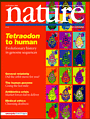
The sequence published this week in Nature by the international consortium, which includes a large number of French groups from CNRS2, covers about 90% of the genome of Tetraodon. For the first time in a fish, the majority of genes identified by sequencing have been identified and localized on the 21 chromosomes of Tetraodon. The scientists found genes which were thought to be absent in fish. Furthermore, they we able to identify 900 new human genes which had not yet been identified, by comparisons with the Tetraodon genome.
The positioning of the genes on the Tetraodon chromosomes has made it possible, for the first time, to compare the chromosomal organization of the genomes of mammals and fish, two lineages in which the common ancestor lived in the Paleozoic era, about 450 million years ago. The examination of the genes of Tetraodon, first within its own genome and then by comparisons with human genes, indicates that the ray-finned fishes, i.e. the majority of fish known today, duplicated their genome shortly after the separation of the two lineages which lead to fish and mammals. " This evolutionary mechanism is well-known in plants but very rare in animals, and a fortiori in vertebrates ", commented Jean Weissenbach. " Its consequences are very important, because this mechanism endows a species with a great potential for the invention of new biological functions. "
By pairing up the duplicated chromosomes in Tetraodon, the scientists were able to reconstitute the structure of the genome of the ancestor of ray-finned fishes. In this way they discovered that the genome of this extinct species was constituted of 12 chromosomes and was probably also very compact. " This genome resembles modern Tetraodon very closely, which is surprising considering the hundreds of millions of years between the two species ", said Jean Weissenbach. " On the other hand, during the same period, the genome of the lineage which led to the human species underwent considerable rearrangement. "
This analysis of the Tetraodon genome made it possible for Genoscope scientists to discover the mosaic of ancestral segments which form the human genome, and to reveal a part of the evolutionary history of the human species starting with the last common ancestor we share with fish.
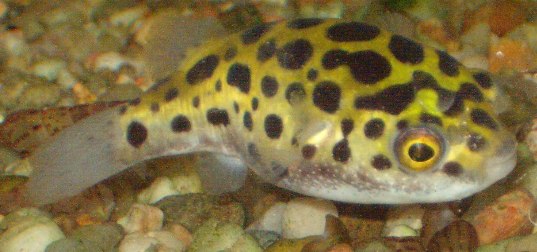
Tetraodon nigroviridis
For more information :
http://www.genoscope.cns.fr/tetraodon
Reference :
Genome duplication in the teleost fish Tetraodon nigroviridis reveals the early vertebrate
proto-karyotype. Olivier Jaillon et al, Nature 21 octobre 2004.
Contacts :
Scientists:
Jean Weissenbach, +33 1 60 87 25 02, jsbach@genoscope.cns.fr
Hugues Roest Crollius, +33 1 44 32 23 70, ,hrc@ens.fr
Olivier Jaillon, +33 1 60 87 25 30, ojaillon@genoscope.cns.fr
Department of life sciences :
Jean-Pierre Ternaux, +33 1 44 96 43 90, jean-pierre.ternaux@cnrs-dir.fr
Press :
Genoscope :Yann Esnault, +33 1 60 87 84 50, yesnault@genoscope.cns.fr
CNRS : Isabelle Tratner, +33 1 44 96 49 88, isabelle.tratner@cnrs-dir.fr
|

1Unité Structure et évolution des génomes, Genoscope-CNRS-Université d'Evry.
2Laboratoire de Biologie Moléculaire de la Cellule, CNRS-INRA-Ecole Normale Supérieure de Lyon ; Département Systématique et Evolution, service de Systématique Moléculaire, Muséum National d'Histoire Naturelle-CNRS ; Défenses Antivirales et Antitumorales, CNRS-Université de Montpellier, Biométrie et Biologie Evolutive, CNRS-Université Lyon 1 ; Laboratoire des Interactions Plantes-Microorganismes, CNRS-INRA, Toulouse.
 home |
overview |
resources |
sequencing |
news |
press releases |
site |
Legal information
webmaster@genoscope.cns.fr

