Botrytis
cinerea (the asexual stage of the teleomorph Botryotinia
fuckeliana) is one of the principal pathogenic fungi of
grapevines, and is responsible for major viticulture losses in France
and the rest of Europe.
B. cinerea is a haploid Euascomycete fungus. It
belongs to the class Leotiomycetes, with a genome size of 30
Mb. It is a model species for the infectious process in
phytopathogenic fungi. This fungus causes infections which are
characterized by the rapid destruction of the tissues of its host
plant as it proceeds to colonize it (necrotrophy).
Why sequence the genome of Botrytis cinerea?
The sequencing project for the genome of the fungus,
B. cinerea, is being done within the framework of the
molecular analysis of the "vineyards and its pathogens" ecosystem
including the Stolbur phytoplasma. The characterization of
the genomes of the grape and its principal pathogens
(B. cinerea, Stolbur) provides the opportunity to
study the mechanisms implicated in the interactions between the
grapvine and its pathogens as well as the dynamics of these pathogens
in the "vineyard" ecosystem.
The production of genomic sequences will make it possible to construct DNA chips for the host plant and its pathogens which will be used to identify the genes induced or repressed during an infection. The validation of these transcriptional analyses will be facilitated by the development of functional genomics tools for each organism. The molecular analysis of both partners in a plant-pathogen interaction is necessary to better understand these diseases and to discover new methods of defense against them.
Economic importance of Botrytis cinerea
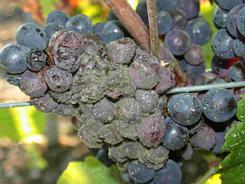
gray mold in vineyards thanks to
B. cinerea (Photo Anne-Sophie Walker © INRA) |
Filamentous fungi are the principal pathogenic agents of plants and
the damage provoked by these microbes is responsible for about 20% of
the crop losses in the world. B. cinerea is the causative agent of
gray mold in vineyards and of diseases in several hundred
other host plants. Losses due to this fungus account for 20% of
harvests of the affected crops in the world, and their cost is
estimated at 10-100 billion euros per year.
Estimated losses for vineyards in France amount to 15-40% of harvests
depending on climatic conditions. Other losses are estimated at 20-25%
of the strawberry crops in Spain, and 20% of cut flowers in
Holland.
The fight against fungal diseases provoked by B. cinerea
requires ths use of fungicides, the modification of cultivation
techniques and the development of resistant or tolerant
cultivars. Fungicidal treatments against B. cinerea cost
about 540 million euros in 2001, which represents 10% of the world
fungicide market (Annual Report, UIPP, 2002). Furthermore, the
magnitude of the fungicidal treatments against this fungus has
provoked the appearance of resistant strains, necessitating the
development of new molecules (Leroux et al., 2002 Pest
Manag. Sci. 58:876).
The damage caused by gray mold have a disastrous economic impact on
numerous crops, notably vineyards in France. There are, however,
specific climatic conditions under which B. cinerea causes
symptoms of noble rot which is essential for the
production of syrupy wines with high profitability such as Sauternes.
Importance of Botrytis cinerea in phytopathology
Because of its polyphagic and necrotrophic characteristics,
B. cinerea is a good model for the study of fungal infectious
processes. This fungus preferentially attacks fruits (grapes,
strawberries, tomatoes) and flowers, upon which it produces a gray
rot. It is also capable of attacking stems, leaves and
seeds. Furthermore, it has been shown in the laboratory that the same
isolate is capable of attacking very different plant hosts (bean,
grapevine, tomato, Arabidopsis, rose) and different organs of the same
plant (fruits, leaves, petals).
B. cinerea causes infections characterized by rapid
destruction (maceration, necrosis) of the tissues of its plant host as
it colonies it (necrotrophy). B. cinerea is therefore an
excellent model for the study of this type of infectious process which
is characteristic of numerous fungal diseases of plants. This fungus
utilizes a large range of pathogenic factors (lytic enzymes, activated
oxygen forms, toxins, plant hormones) to attack its host plants,
including grapevines. Access to its genome should lead to the
identification of genes and functions implicated in this type of
infectious process.
Phylogenetic interest of Botrytis cinerea
The majority of fungal species which are pathogenic for plants are
Ascomycetes from three classes: Sordariomycetes,
Loculoascomycetes and Leotiomycetes.
The Sordariomycete group includes non-pathogenic model
species such as Neurospora crassa and Posdospora
anserina which are used for basic research on essential
biological processes and pathogenic species of plants such as
Magnaporthe grisea and Fusarium graminearum.
The genomes of N. crassa, M. grisea and
F. graminearum have been sequenced (NSF-Broad Institute,
USA), as well as that of P. anserina (Genoscope). There are
no sequences for the Leotiomycetes or the
Loculoascomycetes which are accessible to the scientific
community. A sequencing project for the phytopathogenic fungus,
Sclerotinia sclerotiorum, which belongs to the class
Leotiomycetes, has been initiated in the framework of a
NSF-Broad Institute grant program in 2004. This fungus, although
closely related taxonomically to B. cinerea, differs in many
biological and molecular characteristics (see paragraph below). The
sequencing of B. cinerea should therefore provide a new
genomic resource as a phytopathogenic representative of the
Leotiomycetes.
Botrytis cinerea as a molecular and genetic model
The complete sequencing of Botrytis cinerea will be
facilitated because of the haploid nature of its genome and its
relatively small size (30 Mb). By comparison with the genomes of
Ascomycetes which have already been sequenced, it is
estimated that this fungus has 10,000 to 12,000 genes spread over
about 10 chromosomes. Furthermore, although the molecular biology of
B. cinerea has only been studied for about a decade, all the
tools of classical and molecular genetics (crosses, transformation,
homologous recombination and replacement of genes, insertional
mutagenesis and collections of mutants, ESTs, macroarrays, genomic and
expression libraries) are available for performing studies of
functional genomics.
|





 Laboratoire de physiologie des plantes et des
champignons lors de l'infection
 home |
overview |
resources |
sequencing |
news |
press releases |
site |
Legal information

